
The UK EV-qualified vehicle technician skills shortage explained
1. The UK EV technician workforce is growing
More technicians are qualifying, but the number alone does not settle the question
The UK has more EV-qualified vehicle technicians than it did a year earlier. The Institute of the Motor Industry’s Q4 2025 EV TechSafe Technician Forecast recorded 74,734 technicians with an EV qualification, representing around 35% of the UK technician workforce.
That is higher than the 66,788 recorded in IMI’s Q1 2025 update. The reporting periods differ, but both figures show a growing qualified workforce whose size alone does not show whether supply is keeping pace with demand.
The issue is whether enough technicians have the right qualification and capability for the work vehicles will require.
2. What the latest IMI data actually shows
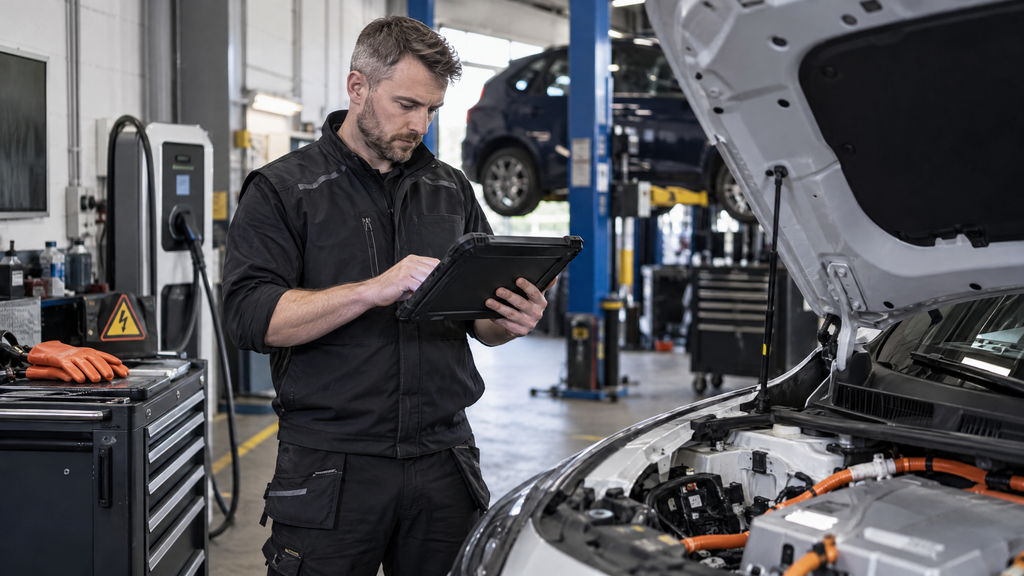
Current supply is increasing, while the rate of growth remains uneven
IMI recorded 2,792 new EV qualifications in Q4 2025, 6% higher than the previous quarter but 17% lower than the same period in 2024. It forecast around 2,394 further certifications in Q1 2026, taking the total to approximately 77,128 if achieved.
These figures count technicians with an EV qualification; they do not mean all 74,734 hold the same qualification, work at the same level or carry out the same EV repairs. IMI’s eligible routes cover different areas of electric and hybrid vehicle work.
The 35% is a workforce proportion, not a measure of workshop capacity or regional availability. It does not show how many regularly work on EVs or have advanced diagnostic and high-voltage experience.
The total must therefore be read alongside the work technicians are trained and prepared to undertake.
3. Why more EV qualifications do not automatically solve the shortage
Qualification, experience and capacity measure different things
An EV qualification demonstrates that a technician has achieved a defined level of knowledge and, where applicable, practical assessment. It gives useful evidence, particularly for safety-critical work, but does not demonstrate years of EV experience.
The current IMI Level 2 Technical Specialist award covers hazards, safe working and the isolation and reinstatement needed for routine maintenance. IMI states that it does not certify someone to work directly on a vehicle’s high-voltage system.
The Level 3 Technical Specialist award is broader. It covers diagnostic, testing and repair activities and the removal and replacement of electric/hybrid high-voltage components. Level 4 covers more advanced diagnosis, testing and repair, including live high-voltage electrical components. Level 3 and Level 4 are not interchangeable and neither should be treated as a general licence for every EV repair.
Practical capability also depends on recency, systems and manufacturers encountered, frequency of work, diagnostic equipment and supervision.
A newly qualified technician is not necessarily incompetent; qualification and practical experience simply measure different aspects of capability.
4. Demand is changing alongside the vehicle parc
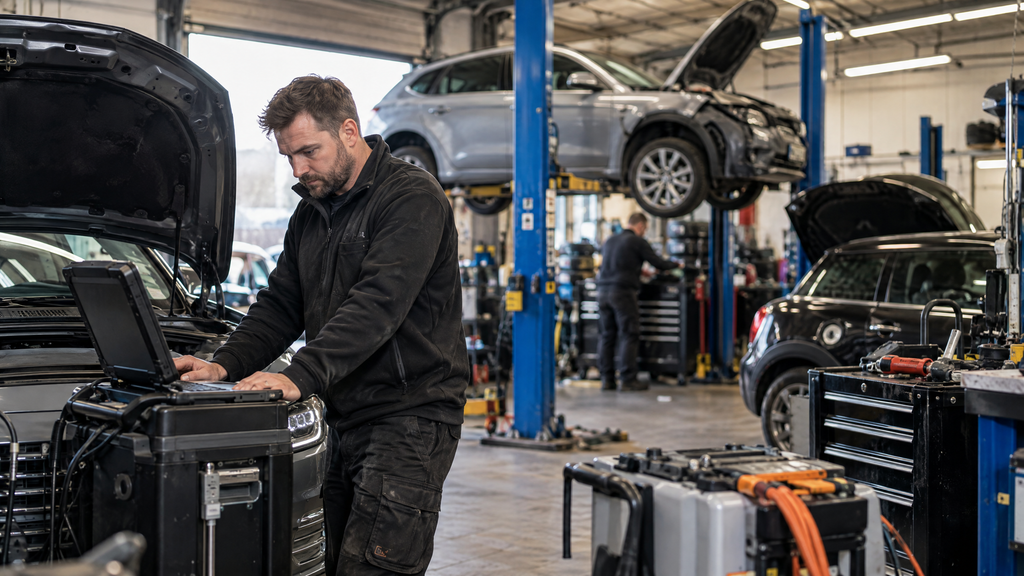
More electrically propelled vehicles create a broader technical requirement
The vehicle parc gives context to the workforce figures. SMMT’s 2025 Motorparc data recorded 42,549,649 vehicles in use in the UK. Around 1.9 million were zero-emission vehicles and around 4.6 million were electrified, using SMMT’s definition covering battery-electric, plug-in hybrid, hybrid and fuel-cell vehicles.
SMMT also recorded 1,797,809 battery-electric cars in use, accounting for almost 5% of the car parc. In August 2026, BEVs represented 29.8% of new UK car registrations, while HEVs accounted for 12.7% and PHEVs 14.5%.
New registrations are not the total parc and BEVs are not all electrified vehicles. The relevant point is that vehicles with electric powertrains or electrically assisted systems are increasing within a large, ageing fleet.
Not every electrified vehicle requires specialist work at every visit. Garages nevertheless need to identify appropriate work, required competence and jobs outside their safe boundaries.
5. The 2032 and 2035 forecasts
IMI expects supply to grow, but demand to grow faster
IMI’s latest forecast projects that the number of EV-qualified technicians could reach around 137,000 by 2032 and 193,000 by 2035. Those are forecasts based on current trends, not guaranteed outcomes.
The same forecast projects that demand will rise faster than supply. Shortages are expected to begin in 2033, with the projected shortfall exceeding 43,000 technicians by 2035. This does not mean that 43,000 technicians will definitely be missing. It represents the estimated difference between the number of qualified technicians expected to be available and the number IMI projects the sector may require under its assumptions.
Qualification growth alone may not be enough if demand expands more quickly as the vehicle parc changes.
Its value is in showing the risk of waiting until demand has overtaken training and workforce development.
6. Why independent garages could feel the pressure
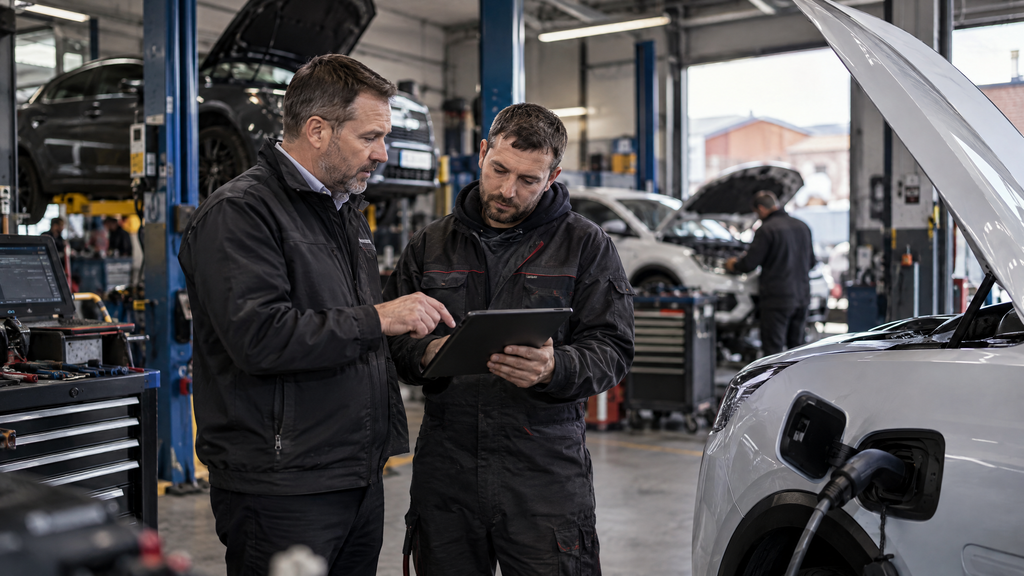
The impact will depend on the work each workshop accepts
Independent garages will not experience the gap in the same way. Routine servicing requires a different level of EV capability from high-voltage diagnosis, component replacement or battery work.
Pressure may appear when a garage must decide whether it can safely accept a job or needs a technician who can work across petrol, diesel, hybrid and appropriate EV repairs.
A mixed-workload garage may need someone with a strong ICE foundation and EV capability at a defined
level, while still referring work beyond that person’s competence.
The practical challenge is matching capability to workload rather than treating “EV qualified” as a complete staffing solution.
7. Qualification, experience and capability are different
What employers should look for behind the certificate
When assessing a candidate, start by checking the exact qualification title, awarding organisation, date and level. TechSafe recognition should also be understood accurately. It is professional recognition within the IMI Professional Register, linked to eligible achievement and continuing professional development. It is not a record of how many EV repairs a technician has completed.
The next questions should concern real workshop exposure. Which BEVs, HEVs and PHEVs has the technician worked on? Have they carried out routine maintenance, safe isolation, component replacement, diagnosis or testing? What technical information and diagnostic platforms have they used? Were they working independently, under supervision or as part of a wider technical team?
For safety-critical work, the candidate should be able to explain how they follow manufacturer procedures and the employer’s safe system of work. HSE says high-voltage systems should be isolated and proven dead before work, using suitable tools and test equipment. Live work should only be considered where there is no other way and it is reasonable and safe.
The employer is looking for sound judgement, clear limits and wider workshop capability, not bravado.
8. What garages can do about the skills gap
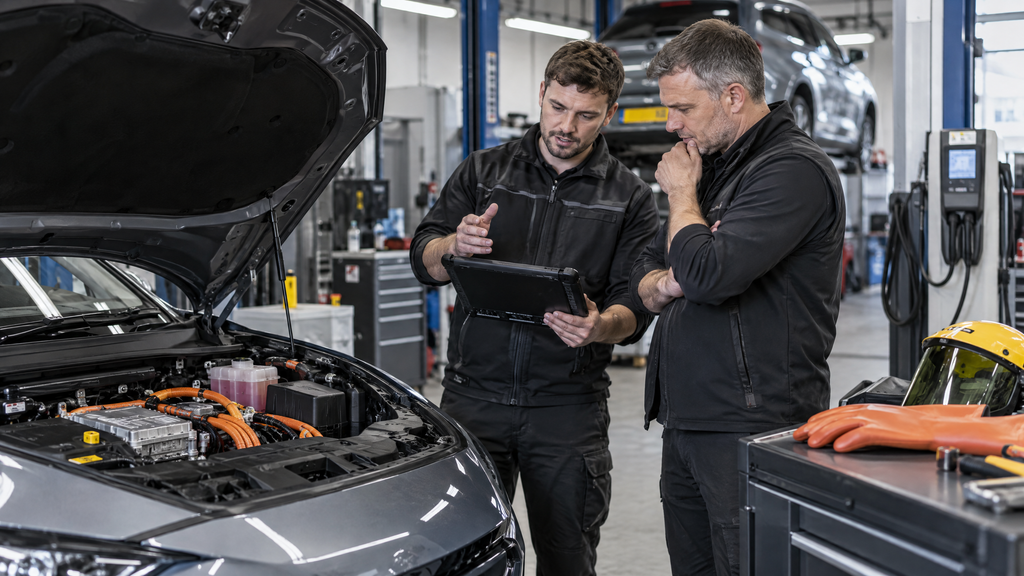
Preparation should begin with the capability the business actually needs
The first step is to define the work. A garage should establish whether it needs routine EV maintenance, safe isolation and reinstatement, high-voltage component replacement, advanced diagnosis or battery-related capability. It should also identify which work will remain outside its scope.
That definition can guide recruitment, training and investment: developing an ICE technician, hiring a multi-skilled technician with appropriate EV training or referring higher-level work.
The qualification level must match the task. Level 2 training is not evidence of direct high-voltage repair competence, while a higher qualification does not prove experience with every battery system or manufacturer.
Assessment can focus on previous work, diagnostic reasoning, information sources, safety decisions and general repair skills. These indicate fit but do not guarantee an outcome.
Early planning gives the workshop time to arrange tools, information, training and supervision before capability becomes urgent.
9. What the UK EV technician shortage means by 2035
Certification growth alone will not close the projected skills gap
The latest IMI forecast points to a growing gap between the number of EV-qualified technicians and the number potentially needed. IMI projects around 137,000 EV-qualified technicians by 2032 and around 193,000 by 2035, while forecasting that demand could exceed supply by more than 43,000 technicians by 2035. These figures are forecasts based on current trends and assumptions, not guaranteed outcomes.
For independent garages, the issue is therefore not simply whether more technicians will gain EV qualifications. The more important question is whether the workforce develops the right combination of qualification, practical experience and capability to handle the range of electric and hybrid work that workshops may encounter.
The garages that prepare early can take a more structured approach to developing EV capability. That means understanding the qualification level required for the work, building practical experience and making sure technicians have the tools, information and safe working procedures needed for the tasks they are expected to perform.
The EV skills gap is therefore best understood as a workforce development challenge, not simply a qualification shortage. By 2035, garages will need technicians whose training and practical capability match the increasingly complex vehicle parc.