
EV workshop safety: What independent garages, dealerships and EV service centres need to get right
1. Introduction: Why EV workshop safety matters
If you walk into your workshop tomorrow morning, can you say with absolute certainty that your team is protected from hazards they cannot see, smell, or hear? The rapid growth of EV servicing in the UK is no longer a forecast; it is a present reality. As electric vehicles become a permanent feature of the UK car parc, the technical demands placed on workshops are fundamentally shifting. Unlike traditional internal combustion engine (ICE) vehicles, where risks are largely mechanical or hydraulic, EVs introduce high-voltage systems operating between 400V and 800V+. This is not simply a new type of powertrain; it represents an entirely new category of industrial hazard.
As an employer, your legal responsibilities are clearly defined. You have a strict duty of care under UK health and safety legislation to ensure that your technicians are not exposed to potentially lethal working conditions. However, safe working environments protect more than just your staff. They also protect your customers from post-repair failures and safeguard your business from catastrophic liability. A safety-first infrastructure is not optional; it is essential for long-term viability. If your workshop is not prepared for the EV transition today, you are effectively placing an expiry date on your business. Safety is the foundation upon which sustainable profitability is built.
2. Understanding EV Hazards in the Workshop
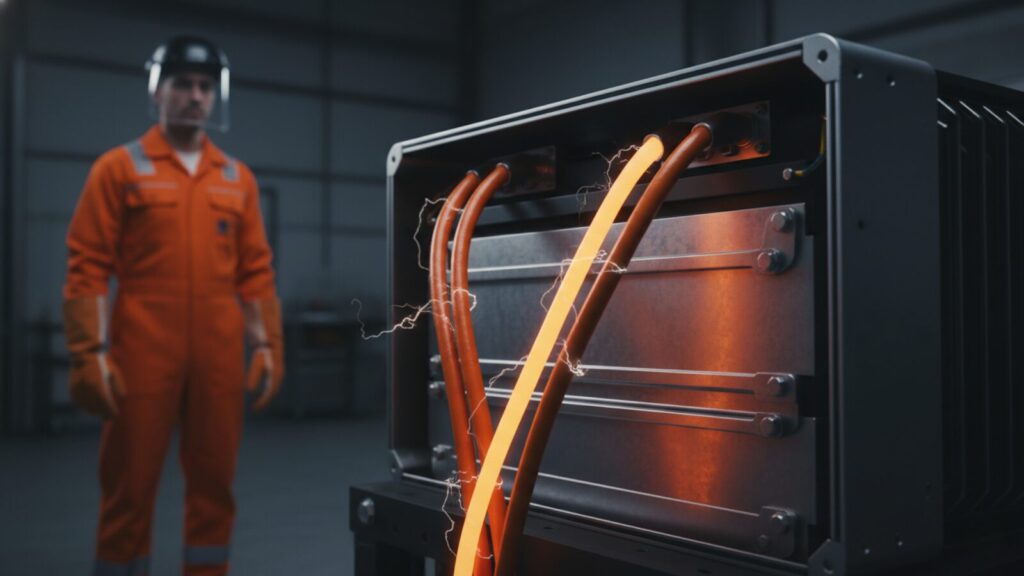
Maintaining a safe environment when servicing electric vehicles requires a fundamental shift in technical mindset. Unlike traditional internal combustion vehicles, EVs contain high-density energy storage systems that can remain live even when the ignition is switched off. Technicians must recognise that the risks associated with EVs are not solely mechanical, but electrical and chemical in nature. Managing these hazards requires strict adherence to safety procedures and the use of specialised, insulated equipment to reduce the risk of life-altering accidents during routine workshop operations.
Electric shock and arc flash:
High-voltage DC systems in EVs can deliver fatal currents capable of causing severe internal injuries or cardiac arrest. In addition to direct contact risks, short circuits can trigger arc flash events, releasing intense heat and light energy that can vaporise metal and cause serious blast injuries.
Thermal runaway:
Thermal runaway occurs when a battery cell enters an uncontrollable self-heating cycle, often due to physical damage or internal faults. These fires generate their own oxygen supply, making them extremely difficult to extinguish using conventional firefighting methods and creating a significant risk of re-ignition long after the initial incident.
Chemical exposure:
Damaged lithium-ion batteries may leak corrosive electrolytes that react with moisture to form hydrofluoric acid. This highly toxic substance can cause deep tissue burns and systemic poisoning. Exposure requires specialised personal protective equipment and immediate decontamination to prevent long-term health consequences for workshop personnel.
The silent hazard:
Because EVs operate without engine noise, a vehicle can be live and capable of movement without any audible warning. This creates a dangerous false sense of safety, increasing the risk of unintended drivetrain activation or high-voltage exposure. For this reason, strict Lock Out, Tag Out (LOTO) procedures are essential.
Adhering to these safety principles is critical to ensuring that the transition to electric vehicle servicing does not compromise workforce safety.
3. Legal and regulatory responsibilities (UK Focus)
In the United Kingdom, the shift towards electric vehicle servicing places significant statutory responsibility on workshop owners and operators. Health and safety legislation is not a set of optional recommendations, but a legally enforceable framework designed to protect employees from the specific dangers associated with high-voltage technology. Failure to embed a culture of compliance does not simply increase the likelihood of technical errors; it exposes the entire business to serious legal and financial risk. A thorough understanding of UK safety regulations is therefore a core requirement of modern workshop management.
The health and safety at work etc. Act 1974:
This primary legislation requires employers to ensure, so far as is reasonably practicable, the health, safety and welfare of all employees. In an EV servicing environment, this includes providing appropriate training, specialist tools and personal protective equipment necessary for working safely with 400V to 800V systems.
The electricity at work regulations 1989:
These regulations apply directly to high-voltage electrical systems used in electric vehicles. They require that electrical equipment is constructed and maintained in a safe condition and that work on live systems is only carried out under strictly controlled and fully documented circumstances where no safer alternative exists.
HSG85 and safe systems of work:
The Health and Safety Executive (HSE) provides detailed guidance through HSG85, emphasising the importance of Safe Systems of Work. This includes adherence to manufacturer-specific procedures, formal isolation processes and the elimination of informal or assumption-based practices that could result in accidental energisation during repair activities.
Consequences of non-compliance:
Failure to meet these statutory obligations can have severe consequences, including invalidation of insurance cover, substantial fines and criminal prosecution. In the event of a fatal incident caused by negligence, company directors may face unlimited fines and potential imprisonment under corporate manslaughter legislation, often resulting in total business failure.
Maintaining comprehensive documentation and consistently applying these legal standards is the only effective way to protect both your workforce and the long-term future of your business.
4. Designing a safe EV workshop layout
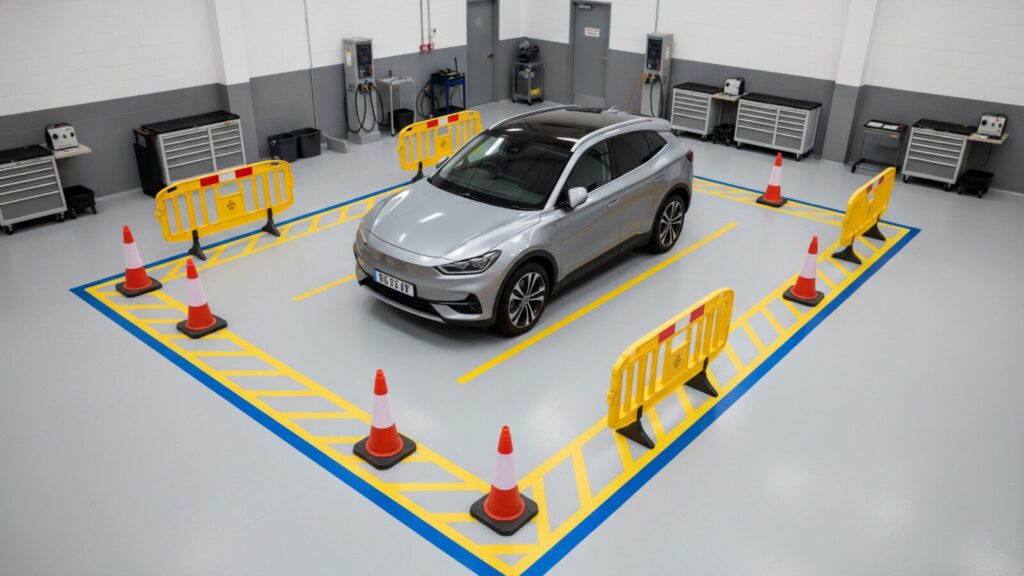
The physical layout of your workshop forms the first and most critical layer of defence when working with electric vehicles. An EV cannot simply be positioned on a standard ramp alongside conventional vehicles with the assumption that existing controls are sufficient. High-voltage work demands a deliberately designed, clearly defined EV work area that reflects the elevated risk profile of these vehicles.
Dedicated EV work bay:
A designated EV bay should be established and clearly separated from general workshop activity. This ensures that EV-specific procedures are followed consistently and reduces the likelihood of unintentional exposure to high-voltage hazards by unqualified personnel.
Exclusion zones:
A clearly marked exclusion zone must be created around the vehicle while de-energisation, testing, or high-voltage repairs are being carried out. Physical barriers, cones, or retractable posts should be used to prevent unauthorised staff, visitors, or customers from entering the area during critical work stages.
Clear signage and floor markings:
High-voltage warning signage, along with floor markings, should be permanently displayed within the EV bay. These visual controls serve as constant reminders that different rules, authorisations and safety protocols apply in this space compared to the rest of the workshop.
Insulated flooring and physical barriers:
The use of dielectric flooring or insulated rubber mats provides an additional layer of protection by reducing the risk of current passing through the technician to ground. Where possible, physical barriers should also be installed to separate high-voltage work from adjacent bays.
Safe storage areas:
High-voltage components removed from vehicles must be stored in a dedicated, fire-rated and clearly labelled area. This includes battery modules, service plugs and high-voltage cables. Storage locations should be dry, secure and protected from impact or unauthorised access.
Emergency access and escape routes:
The workshop layout must allow for unobstructed escape routes at all times. In the event of battery venting, smoke, or thermal runaway, technicians must be able to exit the EV bay immediately without navigating around stored parts, scrap materials, or obstructions. Emergency exits should be clearly marked and kept permanently clear.
A well-designed EV workshop layout not only reduces risk but also reinforces a strong safety culture, demonstrating that high-voltage work is treated with the seriousness it demands.
5. Tools, equipment and PPE for EV work
When technicians are required to work on high-voltage EV systems, the provision of correct tools and protective equipment is not optional; it is a legal and moral obligation. Standard workshop tools and general PPE are unsuitable and potentially dangerous in an EV environment.
Insulated tools:
All hand tools used on or near high-voltage components must be VDE-certified and rated to 1,000V. This includes spanners, screwdrivers, sockets, pliers and torque tools. Insulated tools must be visually inspected before use and replaced immediately if damaged.
Lock Out, Tag Out (LOTO):
A robust Lock Out/Tag Out system must be in place to prevent accidental re-energisation of the vehicle. This involves physically locking the service disconnect or isolator and attaching a clear warning tag that identifies who is working on the vehicle and prohibits reactivation until the work is complete.
Voltage testers and proving units:
High-quality, two-pole voltage testers designed for high-voltage automotive use are essential. A proving unit must also be available to confirm that the tester is functioning correctly both before and after voltage testing. This step is critical to ensure that a false zero reading does not place technicians at risk.
Personal protective equipment (PPE):
Appropriate PPE for EV work includes Class 0 insulating gloves, rated for use up to 1,000V AC. Gloves must be air-tested before every use to check for leaks or damage. Additional PPE includes full-face protection, arc-rated overalls, insulated footwear and eye protection suitable for arc flash hazards.
Provision alone is not enough. Employers must implement a strict inspection, testing and replacement schedule for all EV-specific tools and PPE. Damaged or degraded equipment must be removed from service immediately. Faulty protective equipment is more dangerous than no protection at all, as it creates a false sense of safety.
6. Safe systems of work for EV repair and maintenance
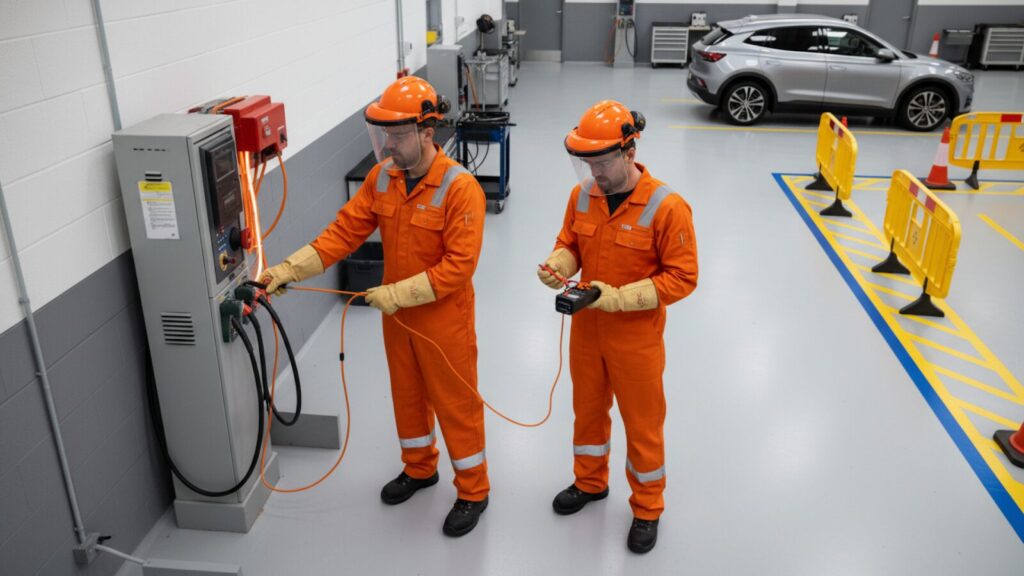
A Safe System of Work is a formally documented, repeatable process that technicians follow every time EV work is carried out. Its purpose is to eliminate reliance on memory, assumption, or informal practices, replacing them with controlled, verifiable procedures.
Isolation procedures:
The isolation of high-voltage systems must be carried out with absolute precision. This includes confirming the system is live, performing the manufacturer-approved isolation process, applying Lock Out, Tag Out controls and then proving the system is dead using approved test equipment. Each step must be completed in the correct sequence without deviation.
Battery handling and lifting:
EV battery packs are both extremely heavy and highly sensitive to impact or deformation. Workshops must use specialist lifting and handling equipment designed specifically for EV batteries, taking into account weight, centre of gravity and manufacturer guidelines. Improvised lifting methods significantly increase the risk of damage and thermal events.
Lone working restrictions:
High-voltage work must never be carried out alone. A second trained and authorised person must always be present or immediately available to initiate emergency procedures if an incident occurs. In the event of electric shock or collapse, immediate intervention can be the difference between life and death.
Documentation and sign-off:
Every stage of isolation, repair, testing and re-energisation must be documented and signed off. This creates a clear audit trail that demonstrates compliance with legal requirements, manufacturer procedures and HSE guidance. Proper documentation also protects the business in the event of investigation, insurance claims, or regulatory scrutiny.
A consistently applied Safe System of Work transforms EV servicing from a high-risk activity into a controlled and professional operation, ensuring that safety, compliance and efficiency are maintained as electric vehicles become a routine part of workshop life.
7. Fire safety and emergency procedures
EV fires are relatively rare, but when they do occur, they present a significantly higher level of complexity and risk than fires involving petrol or diesel vehicles. An electric vehicle fire must never be treated in the same way as a conventional vehicle fire.
Thermal runaway
If a battery pack enters thermal runaway, it can generate extreme heat and sustain combustion for extended periods. In some cases, re-ignition can occur hours or even days after the initial incident. For this reason, workshops should designate a clearly defined quarantine area outside the main building where a compromised vehicle can be isolated safely. This reduces the risk of fire spreading to the wider workshop, adjacent vehicles, or surrounding property.
Fire suppression measures
While water can be effective in cooling battery cells and slowing thermal escalation, traditional fire extinguishers alone are often insufficient. Workshops should consider EV-specific fire blankets, high-volume water access and clear procedures for prolonged cooling and monitoring of affected vehicles. Post-incident observation is essential, as damaged battery packs remain unstable even after flames appear to be extinguished.
Staff training and emergency response
All workshop personnel must be trained to recognise early warning signs such as battery venting, excessive heat, or unusual noises. Staff should know the location of emergency isolation points and understand when and how to initiate shutdown procedures. The correct use of non-conductive rescue hooks must be practised, enabling a colleague to be safely removed from a live electrical hazard without placing others at risk. Regular emergency drills are essential to ensure correct responses under pressure.
Liaison with fire and rescue services
Establishing a working relationship with the local Fire and Rescue Service is strongly recommended. Inviting them to visit the site allows them to familiarise themselves with the workshop layout, EV bays and vehicle types serviced. This preparation can significantly improve response effectiveness during an emergency.
8. The role of technician competence and training
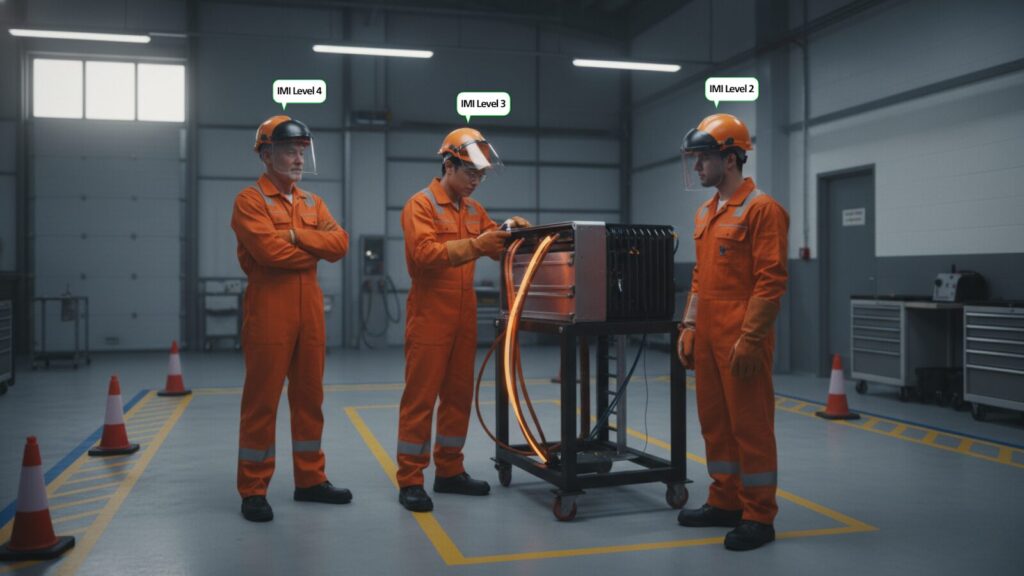
Safety equipment and procedures are only effective when supported by appropriate technician competence. Employers must ensure that each task is matched to the correct level of qualification and experience.
IMI Level 2
This level is intended for personnel who work in proximity to electric vehicles but do not carry out work on high-voltage systems. Typical roles include tyre technicians, valeters and general service staff who require EV safety awareness but are not authorised to access high-voltage components.
IMI Level 3
IMI Level 3 technicians are qualified to de-energise electric vehicles and carry out repair and replacement work on high-voltage components within defined procedures. This level represents the core operational capability required for most EV service and repair work.
IMI Level 4
Level 4 is reserved for advanced diagnostic work and specific live-system tasks. These technicians operate at the highest technical level and require extensive experience, judgement and strict procedural discipline.
It is essential that Level 2 staff are not informally involved in high-voltage work under the supervision of senior technicians. Such practices expose unqualified individuals to unacceptable risk. Clear role boundaries, structured supervision and continuous professional development are critical. As EV technology evolves rapidly, ongoing training is necessary to keep pace with modern 800V architectures and emerging power electronics.
9. Common EV workshop safety mistakes employers make
Even experienced and well-intentioned workshop owners can make decisions that undermine safety. The most frequent errors include:
Assuming ICE processes still apply
Applying internal combustion engine practices to electric vehicles is a serious misjudgement. EV systems introduce fundamentally different hazards that require dedicated procedures.
The “Helper” mistake
Allowing apprentices or unqualified staff to assist in EV bays, even in a limited capacity, significantly increases risk and undermines compliance.
Poor segregation
Carrying out unrelated work in close proximity to high-voltage vehicles or components compromises exclusion zones and emergency access routes.
Expired or uncertified equipment
Insulating gloves, voltage testers and safety equipment that are out of date or uncertified provide a false sense of security and place lives at risk.
Undocumented procedures
Relying on informal or verbal processes is not acceptable. If a safety procedure is not documented, it effectively does not exist from a legal and regulatory standpoint.
10. Future-proofing your workshop for EV growth
The proportion of electric vehicles entering workshops will continue to increase. To remain competitive and compliant, safety systems must scale alongside operational growth.
Investing in people
Workshops must develop structured training pathways that introduce EV safety principles early and support progression through IMI levels over time.
Scaling infrastructure
Workshop layouts should be designed with expansion in mind, allowing additional EV bays to be added without compromising safety zones, fire access, or evacuation routes.
Workforce planning
Identifying and developing future IMI Level 4 technicians is essential. Without proactive planning, businesses risk falling behind competitors who are already fully EV-ready.
11. Conclusion: Safety as the foundation of the EV transition
Safety is not a barrier to business growth; it is the ultimate enabler. By getting EV workshop safety right, you are not simply complying with legal requirements. You are building a workplace that skilled technicians want to join and a service environment that customers can trust.
A clearly structured, safety-led workshop attracts high-calibre IMI-qualified technicians and reinforces professional standards across the business. Over time, this approach builds a reputation for quality and reliability, supporting long-term fleet partnerships, insurer confidence and customer loyalty. As the industry undergoes the most significant shift in automotive history, safety must remain the foundation upon which sustainable success is built.
EV workshop safety checklist
☐ Is the EV work bay clearly designated and properly cordoned off?
☐ Are all insulated tools VDE certified and rated for 1000V use?
☐ Is there a documented and consistently followed Lock-out Tag-out (LOTO) process?
☐ Is all PPE, including insulating gloves and face protection, within certification dates and routinely inspected?
☐ Are technicians trained and authorised to the correct IMI level for the tasks they perform?