
From replacement to repair: The next phase of EV battery servicing
1. The battery replacement debate
A belief that is starting to crack
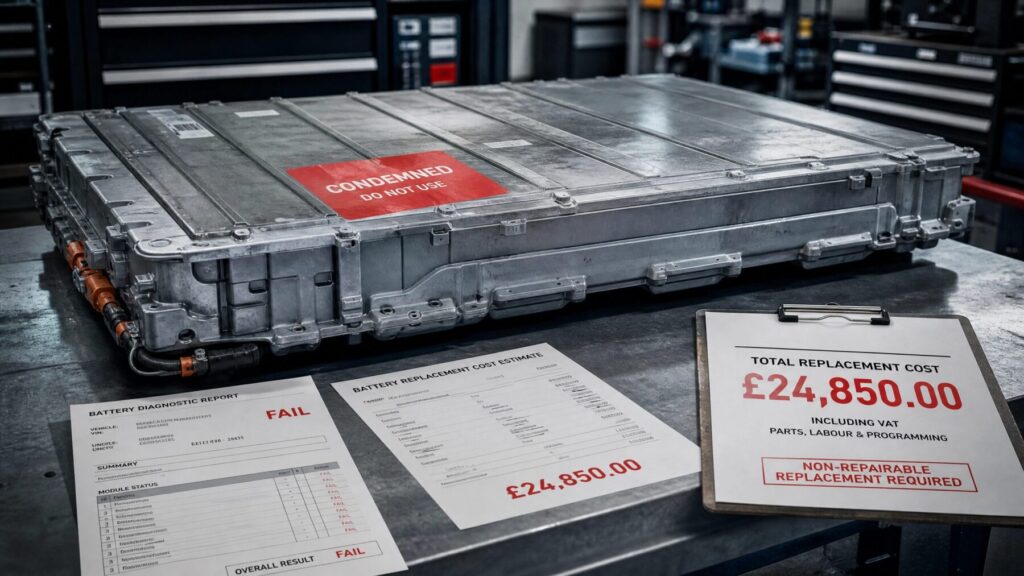
Picture the scene. Your electric vehicle throws up a warning on the dashboard. You take it to your nearest authorised workshop. They run a diagnostic and come back with a figure that stops you in your tracks. A full battery pack replacement. Somewhere between £8,000 and £15,000, before labour. For a vehicle worth £25,000, it is a number that feels impossible to justify.
This is the reality that a growing number of EV owners across the UK are encountering and it has fuelled a widespread belief that when your battery develops a serious fault, replacement of the entire pack is the only option. It is an assumption that has shaped how workshops operate, how insurers model their risk and how prospective buyers think about EV ownership.
But that assumption is beginning to give way. Advances in battery diagnostics, the gradual emergence of module-level repair and the growing recognition of second-life battery applications are pointing toward a different future. Rather than replacing the whole pack every time something goes wrong, the industry is slowly building the foundations for an approach based on repair, refurbishment and reuse. That shift could change the economics of EV ownership significantly and it has major implications for the workshops and technicians who will carry it out.
2. Why full battery replacement became the default
The history behind a costly habit
To understand where the industry is going, it helps to understand how it got here. In the early years of EV adoption, full pack replacement was not arbitrary. It reflected genuine limitations of the time.
The first generation of commercial EV battery packs were largely sealed units. Manufacturers designed them that way for sound reasons: safety, thermal management and warranty control. When something went wrong inside the pack, there was often no approved route to the individual cells or modules. Diagnostic tools capable of identifying a fault at that level either did not exist or were not widely available. If the pack failed, the pack was replaced.
The financial consequences of this approach became impossible to ignore as the UK EV fleet grew. Industry data shows that the battery accounts for between 40% and 50% of an electric vehicle’s total purchase price. A replacement pack for a mid-sized family EV typically costs between £8,000 and £15,000 before labour. When that figure approaches or exceeds the vehicle’s market value, insurers have little choice but to declare it a total loss. An EV that sustains relatively modest damage in an accident can be written off not because the car is beyond saving, but because the battery replacement cost alone tips it past the threshold at which repair becomes economically viable.
This pattern has contributed meaningfully to public concern about EV running costs and given the insurance market a difficult claims environment to manage. The good news is that the industry is now entering a meaningfully different phase.
Industry data from the Association of British Insurers shows that EV battery packs account for between 40% and 50% of a vehicle’s total purchase price. When a replacement battery costs £8,000 to £15,000, even a minor accident can result in a total write-off.
3. The rise of battery diagnostics and module-level repair
Fixing the problem rather than replacing it
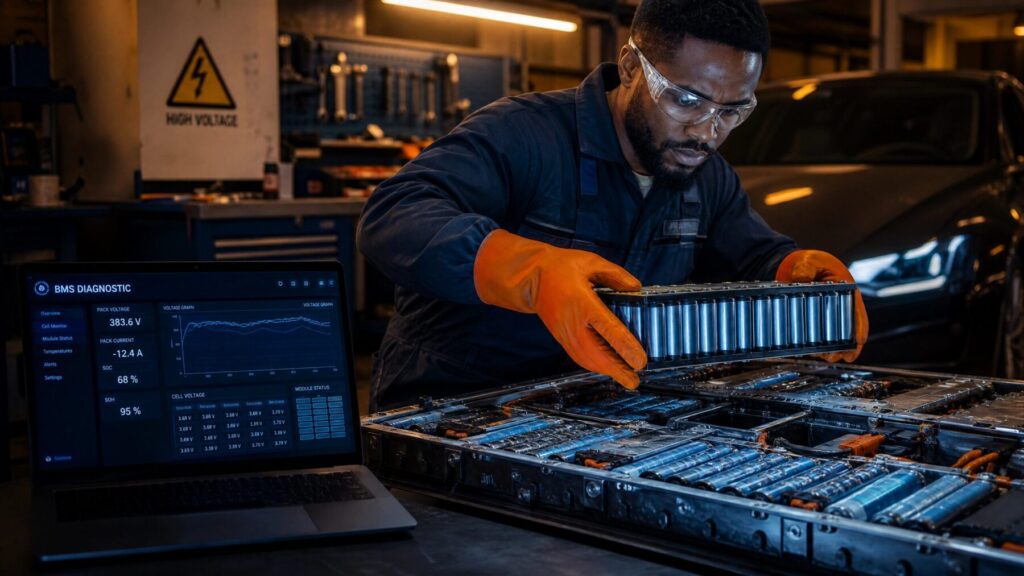
The most significant shift now underway is the growing ability to diagnose and address battery faults at module or cell level, rather than treating the entire pack as a single disposable unit.
UK-based Autocraft Solutions Group has developed its REVIVE battery workshop system, which takes technicians step-by-step through a structured process for triaging, testing and remanufacturing battery packs. The system integrates gas detection, controlled discharge procedures and precise diagnostic tools to identify exactly where within a pack a fault exists. Rather than condemning the whole pack when one module underperforms, technicians using this kind of system can isolate the problem, replace the affected component and return a battery to a verified standard of performance.
Carwood, working with Bosch’s high-voltage battery repair programme, has introduced a similar capability for hybrid vehicles, allowing workshops to replace individual battery modules and restore packs to original equipment manufacturer specifications, with a 48-hour turnaround and free collection from their Coventry facility.
These are still specialist capabilities. Technicians carrying out module-level battery work need to be qualified to at least IMI Level 4, with specific competency in battery management systems, thermal regulation and high-voltage safety. The diagnostic equipment is expensive and the workshop safety infrastructure is significant. But as more of the UK’s 1.3 million battery electric vehicles move beyond manufacturer warranty and into the independent aftermarket, the commercial case for investing in this capability is strengthening fast.
Autocraft’s REVIVE system and Carwood’s Bosch-backed battery repair programme are among the specialist facilities already operating battery repair and remanufacture in the UK. Module-level repair is possible today, but it requires dedicated equipment and IMI Level 4 qualified technicians.
4. Insurance write-offs and the economic impact
The financial case for a different approach
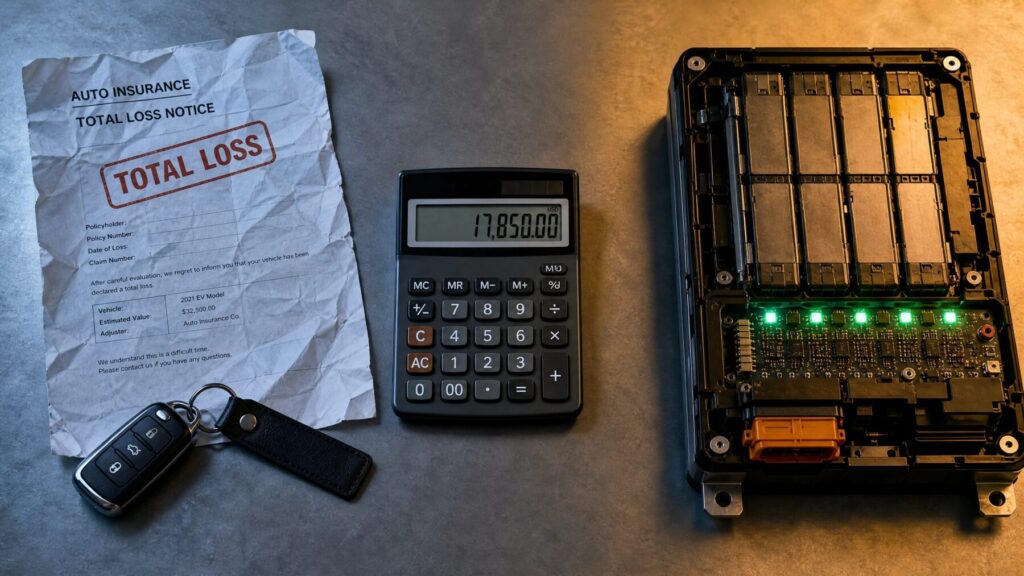
The current default of full pack replacement is causing real financial pain for UK EV owners and the insurance market alike. You might be driving a car that is structurally sound and cosmetically excellent, but if the battery sustains damage that cannot be addressed without a full replacement, your insurer may well write the vehicle off entirely.
Insurers typically declare a total loss when repair costs exceed 50% to 60% of the vehicle’s market value. Given that battery packs account for such a large proportion of an EV’s value, a relatively modest collision can meet that threshold. A three-year-old electric vehicle worth £25,000, requiring a £15,000 battery replacement, is likely to be written off. The vehicle is lost. The parts are lost. And the environmental cost of manufacturing a replacement vehicle is absorbed into the system unnecessarily.
If battery repair and refurbishment become more widely available, a meaningful proportion of these vehicles could be returned to the road instead. For insurers, a repair bill of £3,000 to £5,000 for a targeted module replacement is a very different proposition from a £15,000 full pack replacement followed by a total loss settlement. The economics shift substantially and the incentive to invest in a repair network that can deliver this becomes clear.
For you as a vehicle owner, the implications are equally direct. Repair rather than replacement means lower claims costs, better residual values and a reduced risk of finding yourself underinsured after a write-off settlement.
5. The emerging second-life battery market

Value does not end when the vehicle is retired
Not every battery that reaches the end of its useful life in a vehicle is worthless. This is one of the most important and least understood aspects of EV battery technology.
An EV battery is considered to have reached its automotive end of life when it can no longer hold sufficient charge to meet the vehicle’s performance requirements. The industry standard threshold sits at around 70% to 80% of original capacity. But a battery at 75% of its original capacity is not a spent resource. It still holds a substantial amount of energy and for applications that do not require the high power density demanded by a moving vehicle, it remains highly capable.
Research from the Geotab 2025-2026 study, covering over 22,700 electric vehicles across 21 models, confirmed an average battery degradation rate of 2.3% per year under typical conditions. After eight years of normal use, the average battery retains approximately 81.6% of its original capacity.
These batteries can be repurposed for stationary energy storage: home solar systems, commercial energy management, grid balancing and renewable energy storage. UK-based Connected Energy has built a business around this model, designing large-scale storage systems built from retired EV packs. A Lancaster University analysis found a saving of 450 tonnes of CO2 equivalent for each megawatt-hour of second-life storage installed, compared with equivalent new lithium-ion batteries.
The economics support this strongly. Second-life batteries can cost between 30% and 70% less than new cells for stationary storage applications, making them an attractive option for energy storage developers and businesses looking to manage electricity costs more effectively.
A Lancaster University study cited by Connected Energy found a saving of 450 tonnes of CO2 equivalent for each megawatt-hour of second-life EV battery storage installed, compared with equivalent new lithium-ion systems.
6. The skills challenge
Why the technicians you recruit today will define your position tomorrow
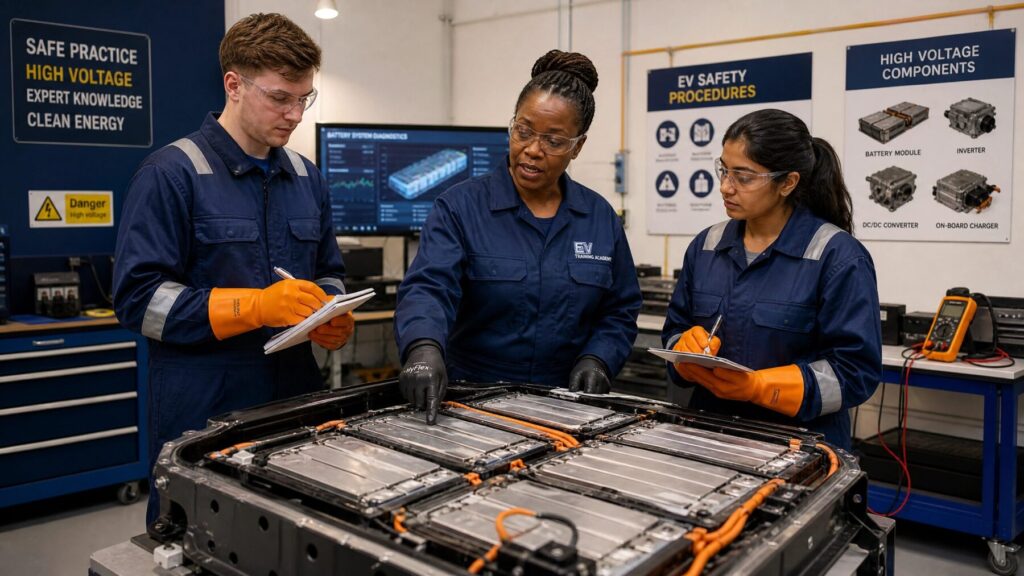
All of this potential, the repair capability, the second-life applications and the shift away from unnecessary write-offs, depends on one thing above everything else: people with the right skills to carry it out safely and competently.
Battery-level repair work is not an extension of standard EV servicing. A technician qualified at IMI Level 3 who services electric vehicles regularly is doing skilled work. But battery pack disassembly, module-level replacement and battery management system diagnostics require a deeper capability: understanding of thermal management systems, accurate interpretation of battery management data and qualification to work safely within high-voltage battery architecture. That combination is currently rare.
The workshops investing in this capability now are gaining a meaningful head start. Specialist labour rates for high-voltage battery work already run between 20% and 40% higher than conventional EV servicing rates, reflecting the scarcity of qualified practitioners. As the UK’s EV fleet ages and more vehicles move out of manufacturer warranty, that premium will only grow.
If you are building or managing a workshop and planning your workforce for the next five years, the capability question is not simply how many EV-qualified technicians you have. It is how many of them have genuine, hands-on experience at the battery level. That is where the next phase of the EV aftermarket will be won.
7. The next phase of EV servicing
Where the market is heading and what it means for you
The EV industry in the UK is still relatively young. Vehicles registered in significant numbers from 2019 onwards are only now beginning to age into the lifecycle stage where battery repair and refurbishment become commercially relevant. The 1.3 million battery electric vehicles on UK roads at the end of 2024 will be joined by millions more as the decade progresses.
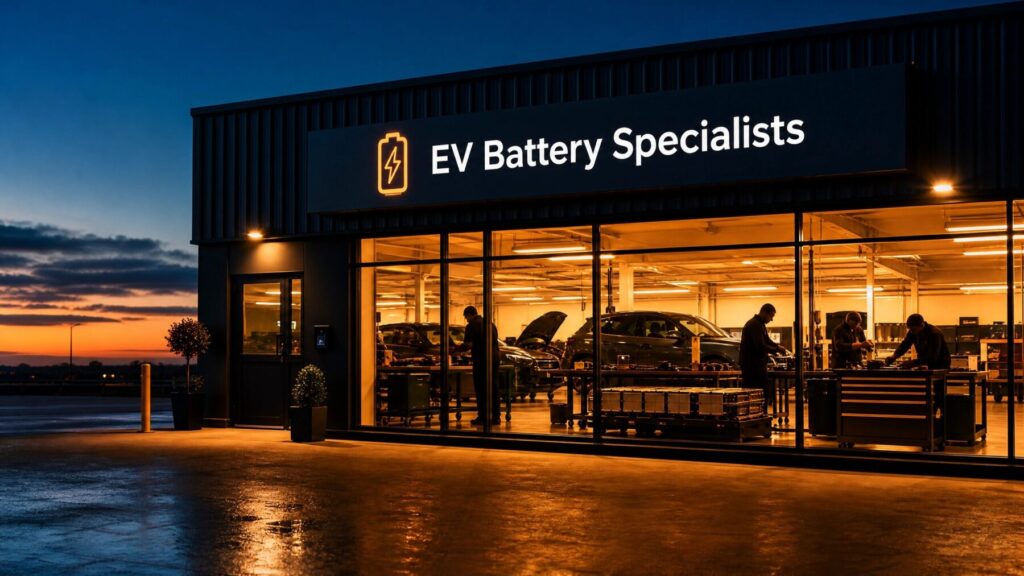
As that fleet grows and matures, EV servicing will shift from keeping vehicles charged and software updated toward diagnosing complex battery faults, repairing packs at module level and managing the end-of-life journey of batteries toward second-life applications.
For workshops, this shift represents one of the clearest commercial opportunities in the aftermarket right now. For insurers, building a relationship with repair facilities that can genuinely address battery faults rather than default to replacement is a direct route to lower claims costs. For the industry as a whole, it is a step toward a more sustainable and economically sensible approach to the vehicles that are supposed to represent a greener future.
The businesses thinking seriously about battery repair capability today are not simply preparing for what comes next. They are shaping it. And the technicians at the centre of that work, those with the skills to open a battery pack, identify a fault and fix it rather than replace it, may well be the most valuable people in the UK automotive aftermarket over the next decade.