
The technician most workshops want but cannot find: What IMI Level 4 actually means
1. The qualification behind the job title
Why Level 4 is not just another certificate
You have probably seen it on CVs, job adverts and workshop profiles across the UK. IMI Level 4. For some employers it has become a shorthand for the kind of EV technician they actually want to hire. For many technicians it represents the qualification they are working toward. But what does it actually mean, what does it take to get there and why does it matter so much in the current market?
Across the UK, only 26% of the automotive technician workforce holds a recognised EV qualification, according to the IMI’s TechSafe data published in late 2025. That figure, published by the IMI in late 2025, puts into sharp relief how few people are genuinely equipped to work on the vehicles that are rapidly filling UK roads. Within that already small group, the number qualified to IMI Level 4 is smaller still.
Level 4 is not simply a higher number on a ladder. It represents a qualitatively different capability, one that the industry needs urgently and one that workshops, fleet operators and recruiters are finding genuinely difficult to source. This article explains what the qualification covers, how you get it and why the distinction between Level 4 and the levels below it matters far more than it might initially appear.
2. Understanding the full IMI EV framework
Four levels, four very different capabilities
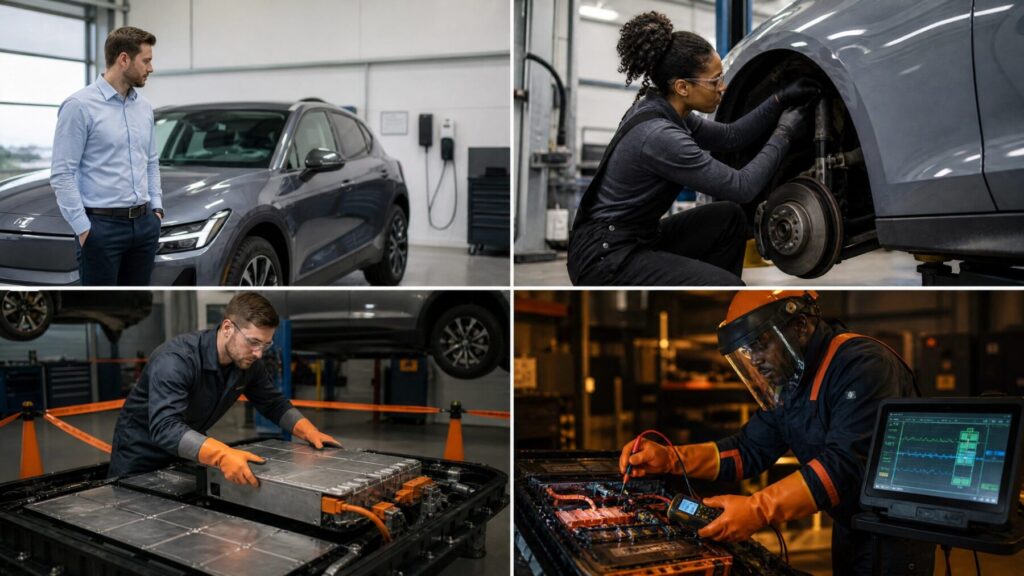
The IMI’s EV qualification framework runs from Level 1 through to Level 4 and the progression is not simply about depth of knowledge. Each level represents a different level of technical competence and authorisation within the workshop.
Level 1 is an awareness qualification for non-technical personnel including sales staff, valeters and parts advisors. There is no practical workshop element and no authorisation to carry out any technical work.
Level 2 covers routine maintenance. Technicians can inspect, service and carry out scheduled maintenance on electric and hybrid vehicles. Crucially, Level 2 does not authorise work on live high-voltage components. The high-voltage system must be fully isolated before any work begins.
Level 3 moves into repair and replacement. Technicians can diagnose faults, remove and replace high-voltage components and carry out more complex work on EV systems. However, Level 3 still stops short of live high-voltage working. The vehicle must be de-energised before a Level 3 technician can access the architecture.
Level 4 is the only qualification in the framework that authorises working on live high-voltage systems. This is the distinction that makes it so significant and so sought after. A Level 4 technician can diagnose, test and repair electric and hybrid vehicle high-voltage components and systems while they are energised. That single capability separates them from every other level in the framework.
Level 4 is the only IMI EV qualification that permits working on live high-voltage vehicle systems. Levels 2 and 3 both require the high-voltage system to be de-energised before work begins. Source: IMI and RWC Training
3. What IMI Level 4 actually covers
Inside the qualification that workshops want most
The full title of the qualification is the IMI Level 4 Award in the Diagnosis, Testing and Repair of Electric and Hybrid Vehicles and Components. It was developed by the IMI in direct collaboration with electric vehicle manufacturers, the Health and Safety Executive and the IMI Sector Skills Council. It is described by the IMI as the first qualification of its kind to address live high-voltage vehicle technology.
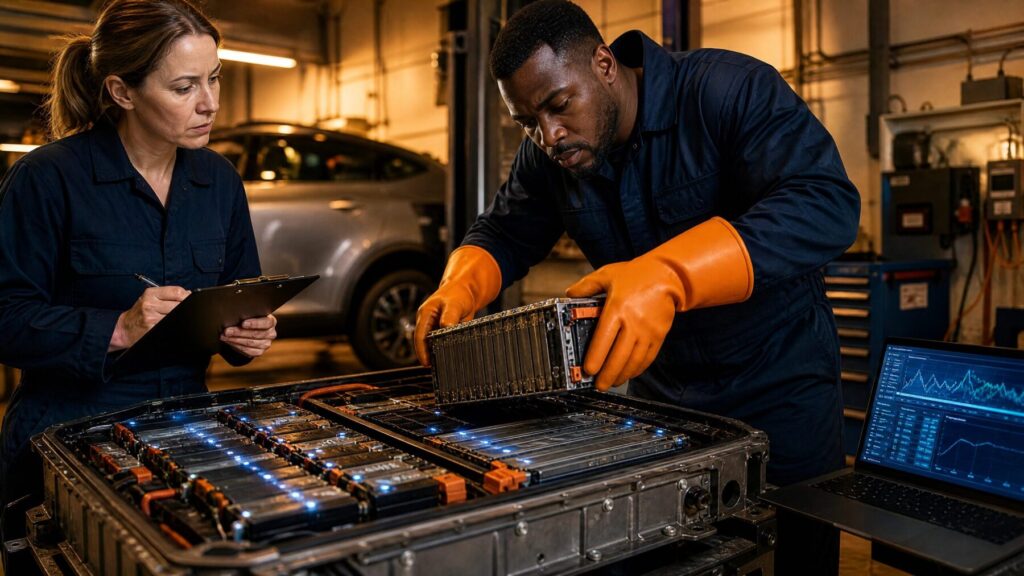
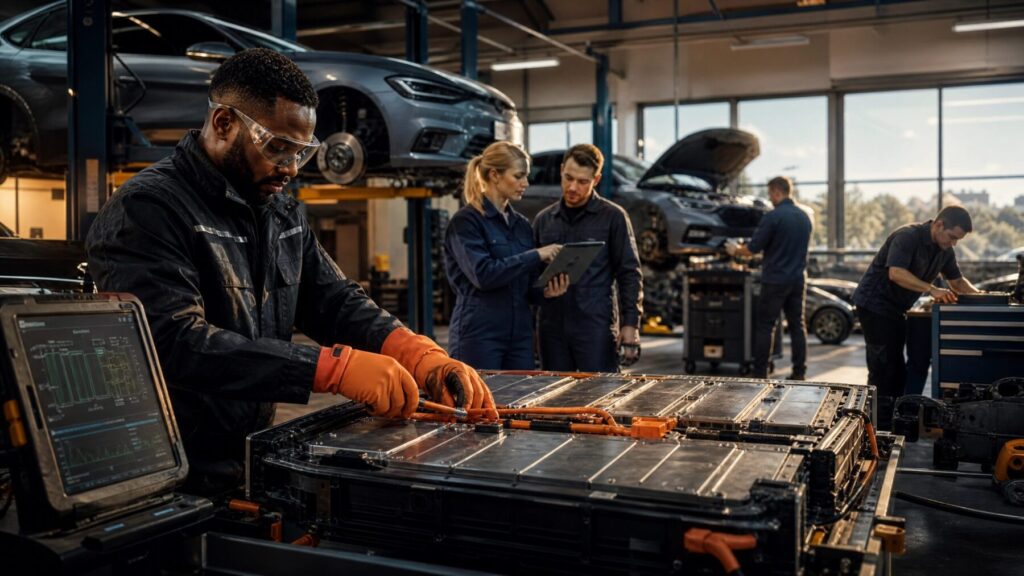
The qualification is built around a single mandatory unit, EV4. The practical assessment tasks within that unit give a clear picture of what a Level 4 technician must be able to do. They must prepare a high-voltage battery for removal from a vehicle. They must safely remove and replace a high-voltage battery module. They must use live data and actuation tests to diagnose faults within the high-voltage system. They must carry out a full functional check on all high-voltage systems following repair. And they must demonstrate safe working practices throughout every stage of the process.
The assessment combines practical work in a live workshop environment, an oral assessment and a written knowledge assignment completed within 28 days of the course. The certificate typically arrives four to six weeks after passing. Most training providers deliver the course over two days, though some run three-day programmes to allow more depth on live systems and safety procedures.
4. Why live high-voltage working is the critical difference
The safety dimension that changes everything
If you have not worked on high-voltage systems before, the significance of the live working authorisation that Level 4 provides might not be immediately obvious. You need to understand what high-voltage actually means in the context of a modern electric vehicle.
Most battery electric vehicles on UK roads today operate at voltages between 400 and 800 volts DC. Some performance and commercial platforms exceed this. For context, the UK domestic mains supply runs at 230 volts AC. The voltage in a typical EV battery system is not merely higher than a domestic plug socket. It is in a category that carries a serious risk of cardiac arrest from even a brief contact and that can cause severe arc flash injuries if a fault occurs during live work.
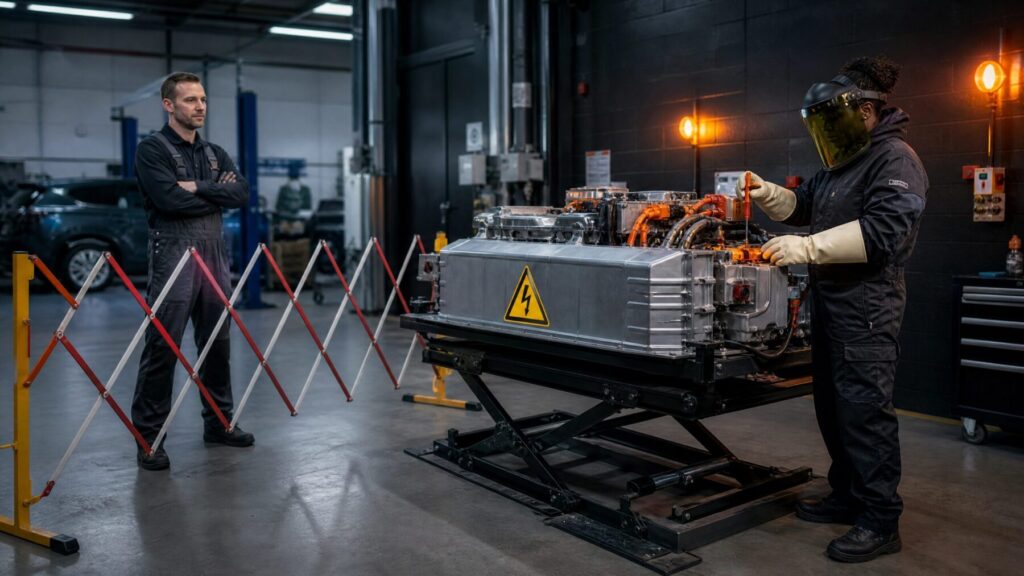
Levels 2 and 3 manage this risk by requiring the technician to isolate and de-energise the high-voltage system before any work begins. This is a well-established and effective safety protocol. But it also places a hard limit on what can be done. Certain diagnostic procedures can only be carried out with the system live. Fault codes that only appear under energised conditions cannot be captured when the system is switched off. Advanced battery diagnostics, live data interpretation and actuation testing all require the system to be powered.
A Level 4 technician has been assessed as competent to carry out live high-voltage diagnostic and repair work safely in accordance with recognised industry procedures. They understand the equipment, the procedures and the legal obligations that apply when working on live systems. That competence is what makes them categorically different from a Level 3 technician and it is why workshops carrying out advanced EV diagnostics and battery repair cannot operate effectively without them.
Modern EVs typically operate at 400 to 800 volts DC. UK domestic mains supply is 230 volts AC. Only IMI Level 4 qualified technicians are assessed as competent to work safely on live high-voltage systems. Source: IMI and industry training providers
5. Who the qualification is for
The right level for the right role
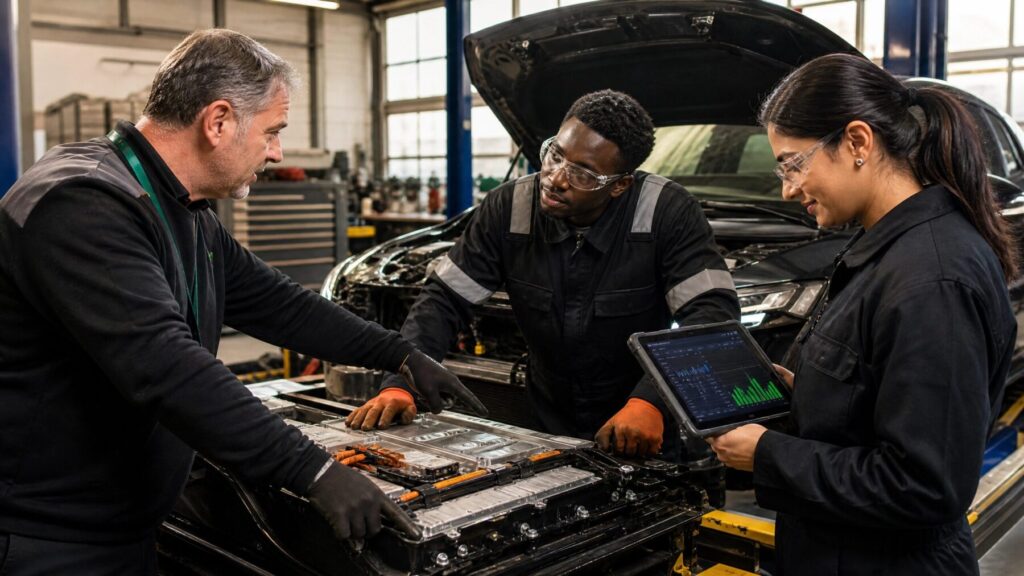
The IMI is explicit about who Level 4 is designed for. It is intended for master technicians, senior technicians and engineers who need the highest level of EV expertise available within the TechSafe framework. If your role involves carrying out advanced diagnostics, working on battery systems or managing complex high-voltage faults, Level 4 is the qualification that gives you the authorisation to do that work legally and safely.
For technicians still building their EV capability, the pathway is clear. Level 2 first, to establish safe working practices and routine maintenance skills. Level 3 next, to develop fault diagnosis and component replacement capability. Then Level 4 for those who want to work at the highest technical level the industry currently recognises.
For employers, the Level 4 qualification is increasingly the benchmark for senior EV technician roles. If your workshop is handling advanced diagnostics, battery module work or complex hybrid system repairs, you need at least one Level 4 qualified technician on site. Without one, there are advanced high-voltage diagnostic and repair tasks that your workshop may not be able to undertake safely or in line with recognised industry practice, regardless of how experienced your other technicians are.
The qualification is also the official entry route into IMI TechSafe recognition. Achieving Level 4 places a technician on the IMI Professional Register, giving employers and customers verifiable evidence of competency they can check directly.
6. The career and commercial value of Level 4
What this qualification means for pay and opportunity
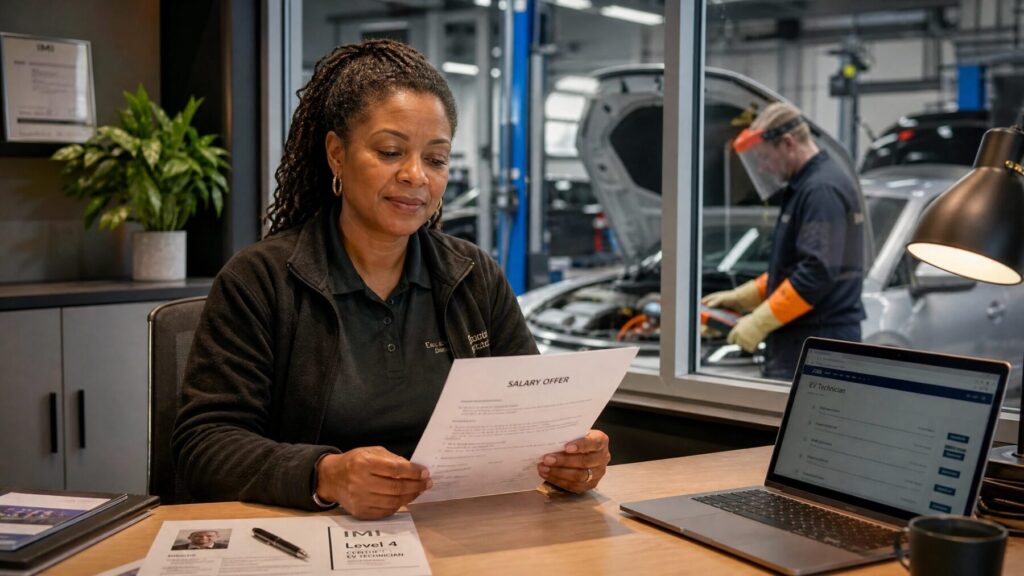
The market value of a Level 4 qualified technician is reflecting the genuine scarcity of this skill. Glassdoor data from March 2026 shows that EV technicians in the UK earn an average of £30,023 per year, with top earners at the 90th percentile reaching £51,628. The typical range runs from £23,647 to £39,133.
Many employers pay a meaningful premium for technicians with live high-voltage capability because the skill remains in short supply. Industry data shows that technicians with live high-voltage competency earn between 20% and 30% more than standard EV servicing rates, reflecting the genuine scarcity of qualified practitioners.
For workshops, the commercial case for having Level 4 capability in-house is equally clear. Advanced diagnostic work and battery-level repairs carry higher labour rates than routine servicing. Workshops without a Level 4 technician are either turning away this work or referring it elsewhere. As the UK EV fleet ages and battery-related faults become more common, the volume of work that genuinely requires Level 4 capability will only grow.
If you are a technician considering the investment in Level 4 training, the trajectory is straightforward. The qualification takes two to three days to complete. The written assignment follows within four weeks. The certificate arrives within six weeks of passing. The career return on that investment, in terms of earning potential and the range of work you can carry out, is significant and growing.
7. The qualification the market cannot get enough of
Where Level 4 sits in the bigger picture
The UK is moving toward a fully electrified vehicle fleet at a pace that the training infrastructure is struggling to match. The IMI’s own data shows that around 74% of UK automotive technicians do not currently hold a recognised EV qualification. Within that qualified 26%, Level 4 certified technicians represent a genuinely rare capability.
That scarcity is already shaping the market. Employers are competing for technicians who can carry out advanced EV diagnostics and live high-voltage work. Workshops with Level 4 capability are winning work that others cannot touch. Technicians who have completed the full IMI framework are finding their qualifications carry real weight in salary negotiations.
The IMI Level 4 Award in the Diagnosis, Testing and Repair of Electric and Hybrid Vehicles and Components is not a nice addition to a CV. For the workshops and technicians operating at the technical frontier of the UK EV aftermarket, it is one of the strongest indicators of advanced EV competence currently recognised across the UK aftermarket. And in a market where that capability is in short supply, it matters more than ever.
Qualification information has been cross-referenced using guidance published by the IMI, RWC Training, Autotech Training and Remit Training. Salary data is based on Glassdoor UK (March 2026). Workforce statistics are taken from IMI TechSafe (Q3 2025)