The skill every EV workshop needs but barely anyone has: Why battery diagnostics is the defining gap of 2026
1. The fault code nobody could read
How a skills gap becomes a real problem in a real workshop
Imagine a customer drives in with an EV showing a persistent battery warning. Your technician connects the diagnostic tool. A fault code appears, but it is not a standard mechanical code. It relates to a cell group imbalance within the battery management system. The technician stares at the data. They know how to service the vehicle. They know the safety protocols. But interpreting what the battery is actually telling them and knowing what to do about it, is a different kind of knowledge entirely. The vehicle sits in the bay. The customer waits. The work cannot be completed.
This scenario is playing out in workshops across the UK with increasing regularity. The problem is not simply that there are too few EV-trained technicians, though that is true. The more specific issue is that even among those who hold an EV qualification, relatively few have developed confident, hands-on capability in battery-level diagnostics. That skill sits at the intersection of electrical engineering, software interpretation and high-voltage safety and it is what the market currently needs most.
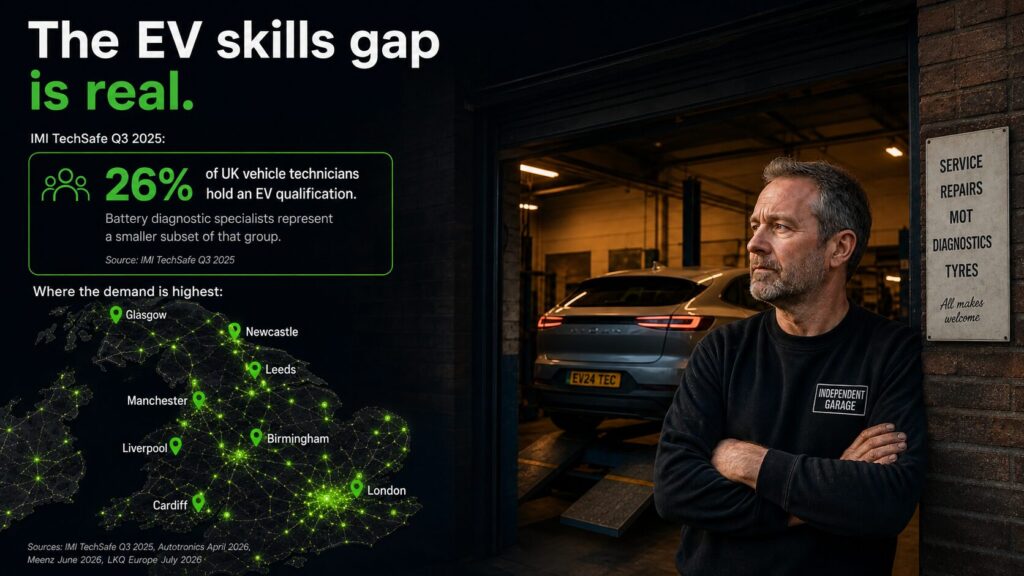
26% of UK vehicle technicians held an EV qualification by the end of Q3 2025, according to IMI TechSafe data. Battery diagnostic specialists represent a smaller subset of that qualified workforce, although published figures for this group are limited. Source: IMI TechSafe Q3 2025.
2. Why EV diagnostics is a different discipline entirely
The shift from mechanical to software-led fault finding
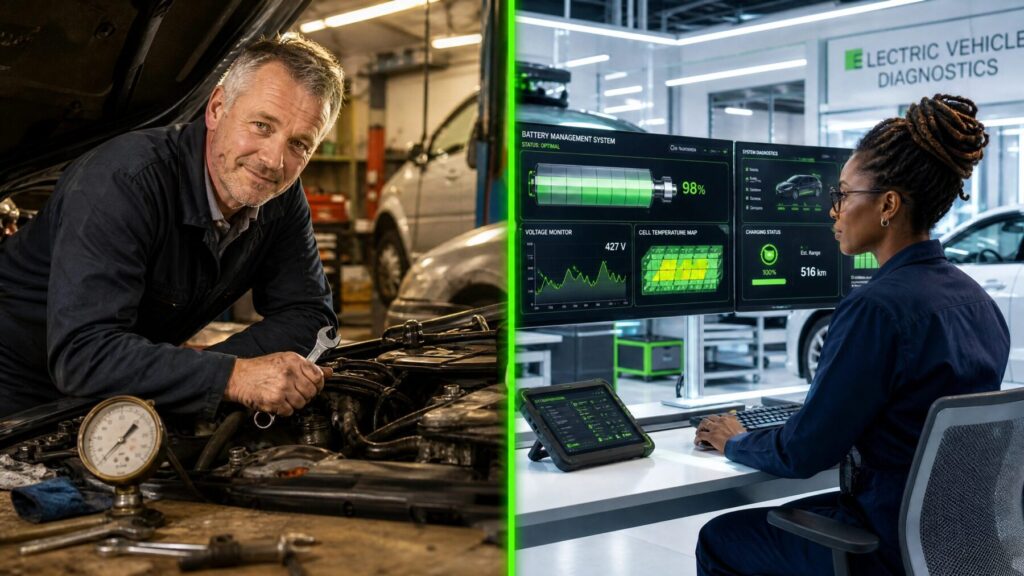
Servicing an electric vehicle is not the same as servicing a conventional one. When a petrol or diesel vehicle develops a fault, a technician can often identify the probable cause through physical inspection, road test observations and fault code reading. The tools are established and the logic is familiar. With an EV and particularly with battery-related faults, the process is fundamentally software-driven. The battery management system monitors individual cell voltages, temperatures, state of health and state of charge across potentially hundreds of cells simultaneously. When something goes wrong, the fault may not be visible or audible. It exists in the data. A technician who cannot read that data confidently is not in a position to carry out a meaningful repair.
Industry analysis published by Autotronics in April 2026 found that the transition from internal combustion engine vehicles to EVs does not simply alter a few tasks on the service sheet. It effectively rewrites it. Fleet EV maintenance eliminates between 15 and 20 traditional ICE tasks but introduces between 8 and 12 new ones, including battery state of health monitoring and thermal management routines. These require specific training and regular practice to develop into genuine competence.
3. The specific skills that are currently hardest to find
What workshops are looking for and struggling to source
The EV diagnostic skills gap is not uniform. Certain capabilities are particularly scarce and understanding which ones helps explain where the demand is most acute.
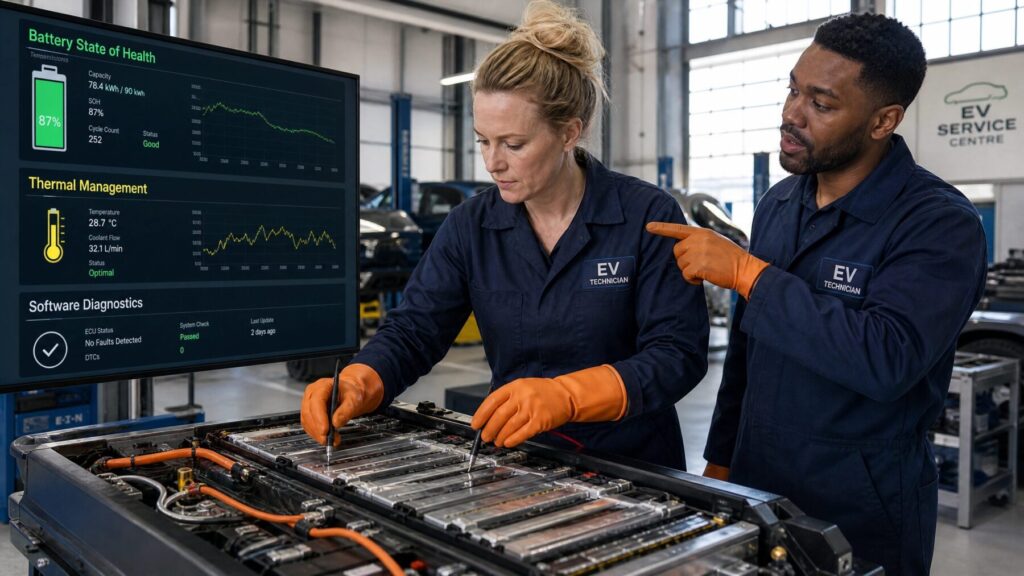
Battery state of health assessment is among the most sought-after skills right now. A technician able to use diagnostic tooling to evaluate individual modules within a battery pack, identify degraded cells and interpret that data against manufacturer thresholds is carrying out work with direct implications for vehicle safety and repair decisions. This skill does not emerge from completing an EV qualification alone. It develops through repeated, supervised practice on live systems.
Thermal management diagnosis is closely related and equally in demand. EV batteries operate within tight temperature ranges and the systems that regulate battery temperature are complex. Faults in the thermal circuit can accelerate degradation, affect charging behaviour and in serious cases create safety risks. Diagnosing these faults requires a technician to hold both the theoretical understanding of how the system works and the practical ability to trace a fault through it.
Software-based fault finding has become a core competency in its own right. Modern EVs are software-defined vehicles. Battery diagnostics, over-the-air update management and control module programming are all part of the repair process and a technician who cannot navigate proprietary diagnostic software confidently is limited in the work they can complete. As noted in analysis published by Meenz in June 2026, interpreting diagnostic data accurately is now as important as any physical inspection skill.
Battery diagnostics, thermal management and software-led fault finding are identified across multiple industry sources as the three most in-demand and hardest to source EV diagnostic skills in the UK market in 2026. Sources: Autotronics April 2026, Meenz June 2026, LKQ Europe July 2026
4. Where the qualified people are and where they are not
A skills distribution problem as much as a numbers problem
The UK is not short of EV-qualified technicians only in terms of raw numbers, though the numbers are concerning enough. It is also dealing with a distribution problem that makes the effective shortage considerably worse than the headline figures suggest.
IMI TechSafe data and analysis from Lloyd Morgan Group published in February 2026 both point to the same pattern: EV-qualified technicians remain heavily concentrated within the franchised dealer network. The independent sector, which represents the majority of UK repair workshops and serves the largest share of the vehicle population, has relatively limited access to this capability. As EVs move through their lifecycle and out of manufacturer warranty into the independent aftermarket, this imbalance is becoming a practical barrier to vehicle servicing.
The pace of training is also a concern. The number of technicians gaining an EV qualification in Q3 2025 fell by nearly 13% compared to Q1 of the same year. Almost 473,000 new battery electric vehicles were registered in the UK in 2025 and used EV transactions rose 45.7% to a record 274,815. The IMI has projected a shortfall of around 35,700 qualified technicians by 2030 and a potential deficit exceeding 44,000 by 2035, based on current trends.
These figures should be treated as projections based on current trajectory rather than certainties. What they indicate reliably is that the gap between EV volumes and available diagnostic capability is widening rather than closing and that independent workshops are bearing a disproportionate share of that pressure.
5. There is a second barrier that receives less attention
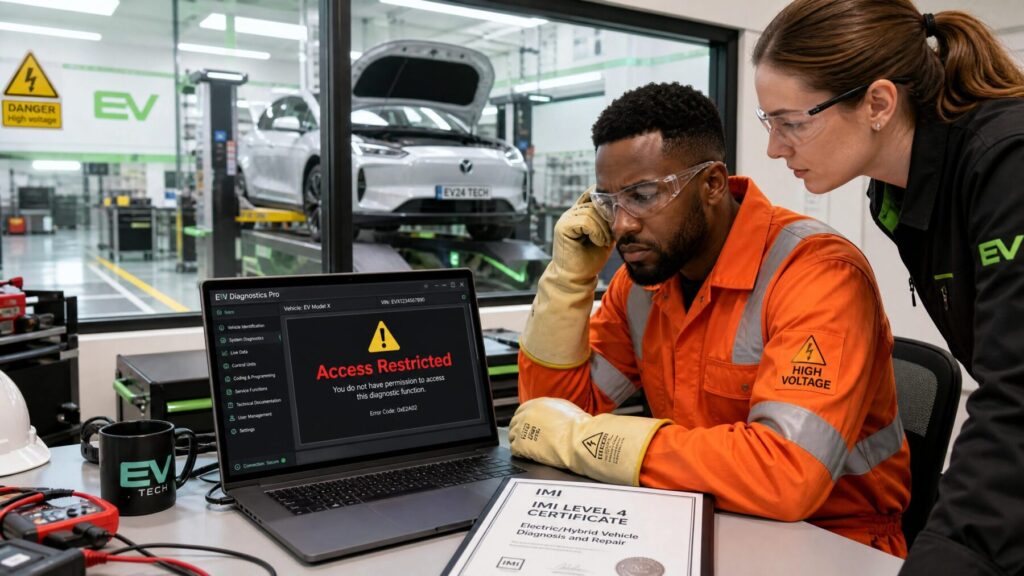
Qualification alone does not guarantee the ability to complete the repair
Even when a workshop has an IMI-qualified technician available, there is a second barrier that the industry has been slow to address. As Marcel Wendt, founder of Digidentity, noted in analysis published by AM Online in June 2026, even fully qualified technicians often cannot access the diagnostic and software systems that modern EVs depend upon. Without that access, the qualification has limited practical value in a live repair scenario.
Vehicle manufacturers have developed proprietary diagnostic platforms that control access to battery data, software updates and module programming. In many cases, this access is restricted to authorised dealer networks. An independent technician with genuine diagnostic skill may find that tools available outside the franchise network do not provide the same depth of data, limiting what any repair can achieve.
This is not a skills problem in the traditional sense. It sits at the boundary between skills, infrastructure and industry policy. Understanding the access environment for the vehicle brands most common in your area is a practical part of building a realistic EV diagnostic service.
6. What this means for workshops planning ahead
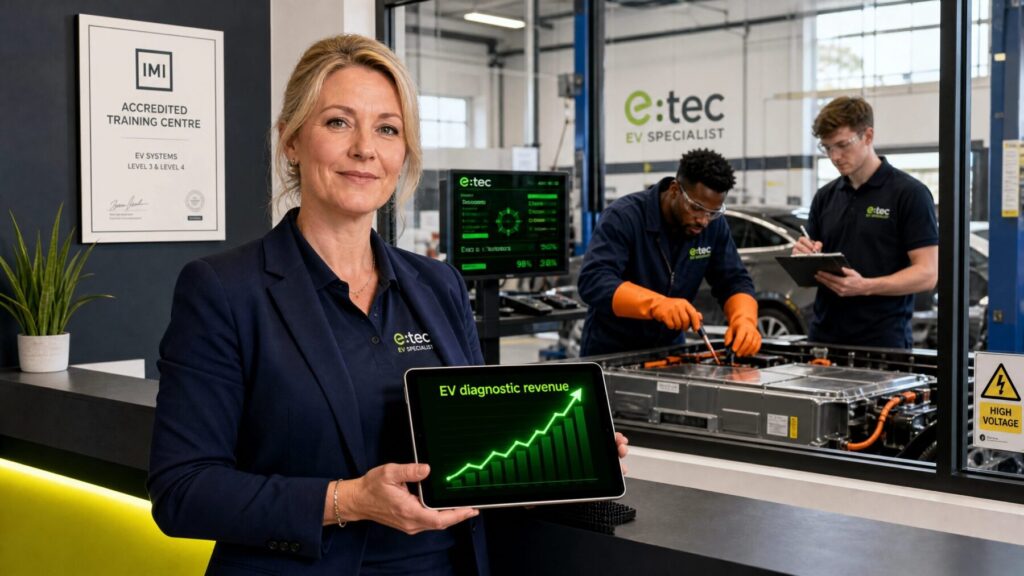
Turning the skills gap into a competitive position
The shortage of battery diagnostic capability is a problem for the industry as a whole. For individual workshops willing to invest in closing it, it is also an opportunity. According to Autotronics, workshops investing in dedicated battery diagnostic tooling and training technicians to interpret state of health data are well positioned to benefit from increasing demand for advanced EV diagnostics. That interpretive skill helps distinguish workshops capable of proactive battery assessment from those focused solely on reactive repair.
Building this capability takes deliberate effort. Completing an IMI Level 4 course is a necessary first step but is not sufficient on its own to develop battery diagnostic depth. Structured exposure to real diagnostic cases, mentored by someone with experience, is how interpretive skill develops. Workshops that build internal learning structures around battery work, rather than relying on qualifications alone, develop the most durable capability.
Workshop managers and employers increasingly report strong demand for candidates with demonstrable battery diagnostic experience. For technicians, developing this capability is one of the clearest ways to strengthen long-term career prospects, particularly as the overall EV-qualified workforce grows while battery-specific expertise remains comparatively scarce.
7. The skill that will define the next phase
Battery diagnostics is not a future requirement. It is a present one.
The UK EV fleet is growing and ageing simultaneously. Many EVs registered from 2020 onwards are beginning to enter a stage where battery health assessment is becoming increasingly relevant for maintenance and repair decisions. Workshops that develop this capability early are likely to be better positioned as demand for battery diagnostics continues to grow.
The skills gap in battery diagnostics is real and, based on current data, widening. Independent workshops are under-served. Training pace is slowing. Vehicle volumes are rising. These are the conditions in which specific, hard-to-find capability becomes most valuable.
The technicians who develop genuine battery diagnostic expertise now are not simply keeping up with the market. They are getting ahead of a demand curve that most of the industry has not yet fully recognised. For the workshops that support and recruit them, the same logic applies. The time to build this capability is before the demand peaks, not after.
Sources: IMI TechSafe Q3 2025, SMMT EV registration data 2025, Autotronics April 2026, Meenz June 2026, AM Online/Digidentity June 2026, Lloyd Morgan Group February 2026, LKQ Europe July 2026, D2P Autoparts March 2026. IMI shortfall projections are based on current trends and should be treated as indicative rather than definitive forecasts.