
Why Chinese EVs are so good: The battery, technology and industrial strategy behind China’s rise
1. How China became an EV powerhouse
A question worth asking properly
Picture a BYD Seal sitting on a UK forecourt, priced competitively against a Volkswagen ID.4, equipped with a sophisticated battery system and an eight-year warranty. A decade ago, that sentence would have made little sense to most British car buyers. China was simply not part of the conversation when it came to passenger vehicles. Today it sits at the centre of it. In 2025, Chinese companies held over 70% of the global EV battery market and China accounted for approximately 62% of all EV sales worldwide. That shift did not happen by chance and it was not simply a matter of cheap labour. It resulted from a deliberate and sustained combination of government investment, battery technology development, supply chain control, manufacturing scale and the kind of intense domestic competition that forces rapid improvement.
2. China saw the EV opportunity early

Why a long-term strategy made all the difference
China’s first major EV subsidy programme launched in 2009, when its automotive industry was still catching up with established Western and Japanese manufacturers. The strategic logic was clear: in conventional vehicles, China was competing against decades of accumulated expertise. In electric vehicles, the playing field was closer to level. Between 2009 and 2023, China’s EV industry received at least $231 billion in government support, according to research by the Center for Strategic and International Studies, covering buyer rebates, tax exemptions, infrastructure funding and research programmes. By 2025, China had built 1.8 million public EV charging points, fourteen times more than the United States despite having a population only four times larger. That infrastructure investment reduced range anxiety and created the large domestic market that gave Chinese manufacturers the scale to compete globally.
China’s EV industry received at least $231 billion in government support between 2009 and 2023. By 2025, the country had 1.8 million public charging points, fourteen times more than the United States. Sources: CSIS June 2024, ALJ Perspective
3. Lithium-ion batteries: The foundation of China’s EV advantage
Why the battery changes everything
The battery is not simply a component in an electric vehicle. It is the vehicle’s defining system. It determines range, charging speed, safety, longevity and a significant portion of the purchase price. In a conventional car, the engine and drivetrain represent the core engineering challenge. In an EV, the battery pack takes that role entirely.
Two main battery chemistries dominate the current market. NMC batteries use nickel, manganese and cobalt, offering high energy density and strong cold-weather performance. LFP batteries use lithium iron phosphate, offering lower energy density but better safety, longer cycle life and lower cost. LFP packs cost approximately $81 per kilowatt hour in late 2026, roughly 20 to 30% cheaper than NMC equivalents and achieve 2,000 to 5,000 charge-discharge cycles compared to around 1,000 to 2,000 for NMC. China leads in both chemistries. CATL and BYD held a combined global battery market share exceeding 55% in 2025, with Chinese companies overall accounting for over 70% of all EV battery installations worldwide.
4. China’s battery supply chain advantage
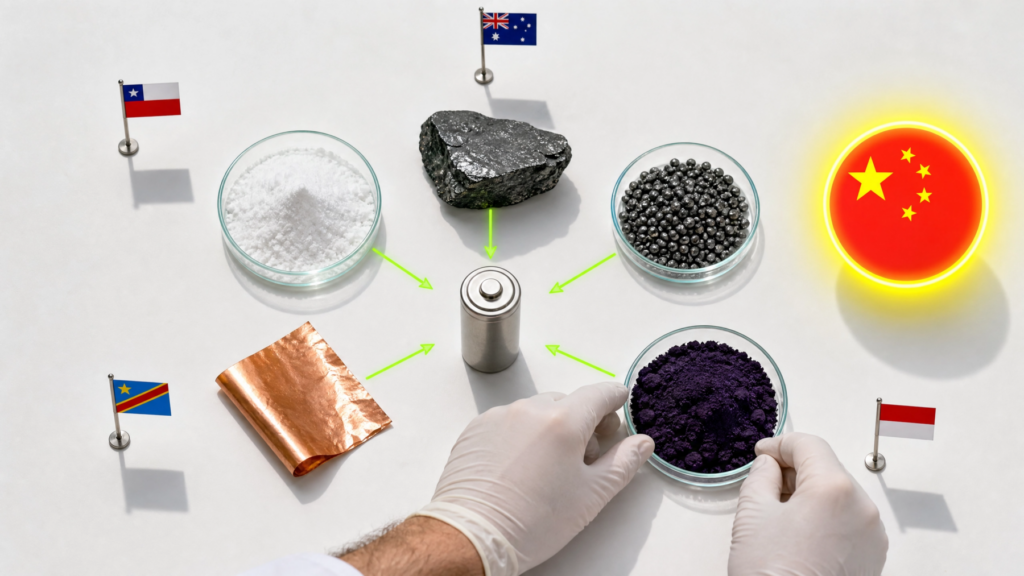
Control of materials and processing, not just production
China’s battery advantage is sometimes reduced to access to lithium, but that understates the reality considerably. China processes the substantial majority of the world’s lithium, cobalt, graphite and nickel into battery-grade materials and dominates cathode and anode production, cell manufacturing and pack assembly. Chinese companies have also invested significantly in securing overseas mineral resources. A Western manufacturer building a battery factory still typically depends on Chinese-processed materials entering its supply chain at some point. That dependency represents a structural advantage that cannot be closed simply by building more factories elsewhere.
5. CATL, BYD and Chinese battery innovation
Technology that consumers actually experience
Battery innovation at CATL and BYD has moved beyond incremental improvement. BYD’s Blade Battery, introduced commercially in 2020 and refined since, eliminated the traditional module layer between cells and pack entirely. Using cell-to-pack technology, long blade-shaped LFP cells are arranged directly into the battery structure, increasing space utilisation by more than 50% compared to conventional LFP packs. The structural simplification reduces secondary components by around 40%, cutting pack costs meaningfully.
The safety of the Blade Battery has been demonstrated through extreme testing. When subjected to nail penetration, which causes immediate thermal runaway in conventional NMC cells, the Blade Battery showed no fire and no smoke. BYD backs it with an eight-year or 250,000 kilometre warranty guaranteeing at least 70% state of health. CATL has pursued parallel advances in fast charging, including technology demonstrated under test conditions in 2025 capable of adding substantial range in under ten minutes.
CATL held a 39.2% global EV battery market share in 2025, the highest of any company worldwide. Chinese manufacturers collectively held over 70% of global EV battery installations. Source: SNE Research, February 2026
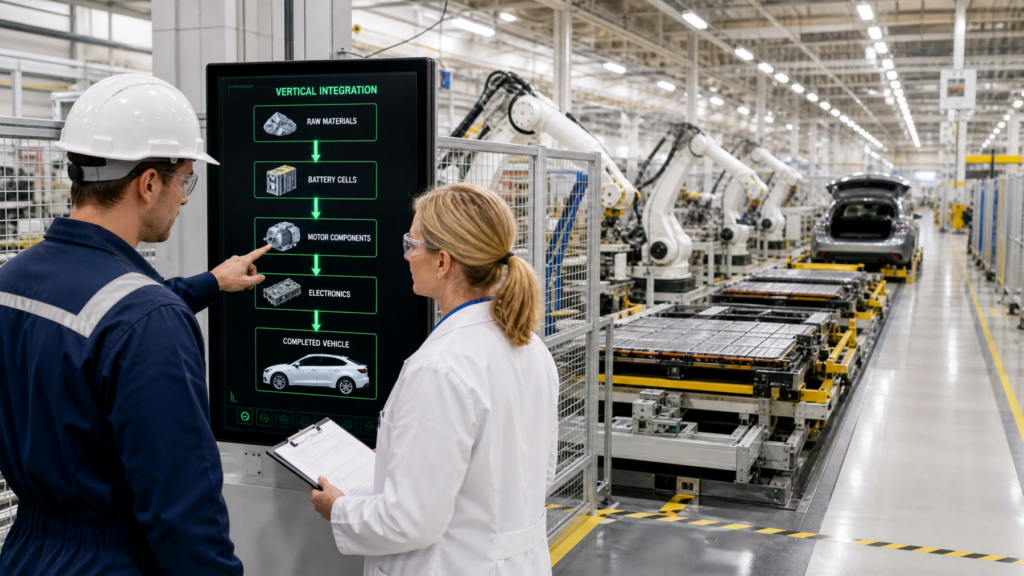
An EV ecosystem, not just EV factories
BYD’s competitive position illustrates why vertical integration matters so much in this industry. The company manufactures its own batteries, semiconductors, electric motors and a significant proportion of its body components. It controls more of its own supply chain than almost any other vehicle manufacturer on earth. That control reduces exposure to external cost pressures and allows design, engineering and production to be optimised together rather than separately.
China’s broader manufacturing base reinforces this. Decades of electronics production have created a deep ecosystem of component suppliers, automation specialists and precision manufacturers. The same supply chains that produce smartphones and consumer electronics feed directly into EV production, giving Chinese manufacturers access to technology and components at costs that reflect domestic rather than import pricing.
7. Fierce competition inside China
How a crowded home market accelerates development
China’s domestic EV market is not simply large. It is intensely competitive, with hundreds of models contending on price, range, charging speed, interior quality, software capability and design. Development cycles are short. A feature appearing on one model is replicated or improved upon by competitors within months. That competitive pressure produces vehicles that are exceptionally well equipped for their price and explains why Chinese EV development moves faster than most Western observers expect.
8. Software, electronics and the smartphone on wheels
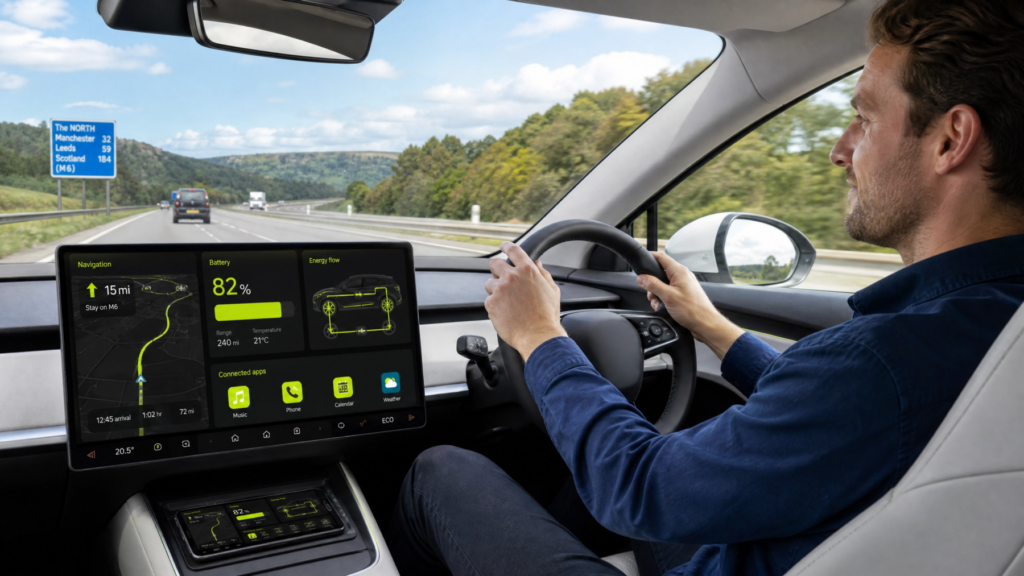
Where China’s consumer technology expertise becomes an EV advantage
Modern electric vehicles are as much software products as mechanical ones. Large touchscreen displays, over-the-air updates, smartphone integration, driver assistance systems and connected services are now central to the ownership experience. China’s strength in consumer electronics translates directly here. Companies that have spent years building sophisticated software for mobile devices bring that capability into vehicle development naturally and the results are visible in the infotainment and software quality of current Chinese EVs.
9. Why Chinese EVs offer so much for the money
Competitive value rather than cheap products
The competitive pricing of Chinese EVs is the direct result of everything described above. Battery expertise, supply chain control, vertical integration, manufacturing scale and domestic competition all compress costs at every stage of production. A Chinese manufacturer building an EV does not need to source batteries externally, does not pay import prices for key materials and does not carry the overheads of a manufacturing base built for conventional vehicles. The better Chinese EVs on the market are not cheap in the sense of being poorly made. They are competitively priced because the cost of producing them is genuinely lower.
10. The downsides and challenges facing chinese EVs in the UK
A balanced picture requires acknowledging the genuine concerns
The challenges facing Chinese EVs in the UK are real and should not be dismissed. Brand recognition and consumer trust remain a barrier, particularly among older buyers. Auto Trader research from January 2025 found that four in ten UK consumers would consider a Chinese brand, but support among over-55s was only 25%. Insurance presents a more immediate practical problem. Research published by Regit in February 2026 found that the Skywell BE11 could be insured by only one major provider at an annual premium of £2,203, compared to an average of £838 for the Peugeot E-3008 across nine insurers. Some Chinese EVs cost up to three times more to insure than comparable European models.
Residual values are also under pressure. Data from Indicata showed the average three-year-old EV in the UK was worth just 38% of its original value, partly reflecting uncertainty around Chinese brands in the used market. Parts availability, long-term reliability data and the depth of UK service networks vary significantly between brands and quality on offer differs considerably across the market.
11. The missing piece: Building a stronger UK aftermarket
Selling vehicles is only the beginning
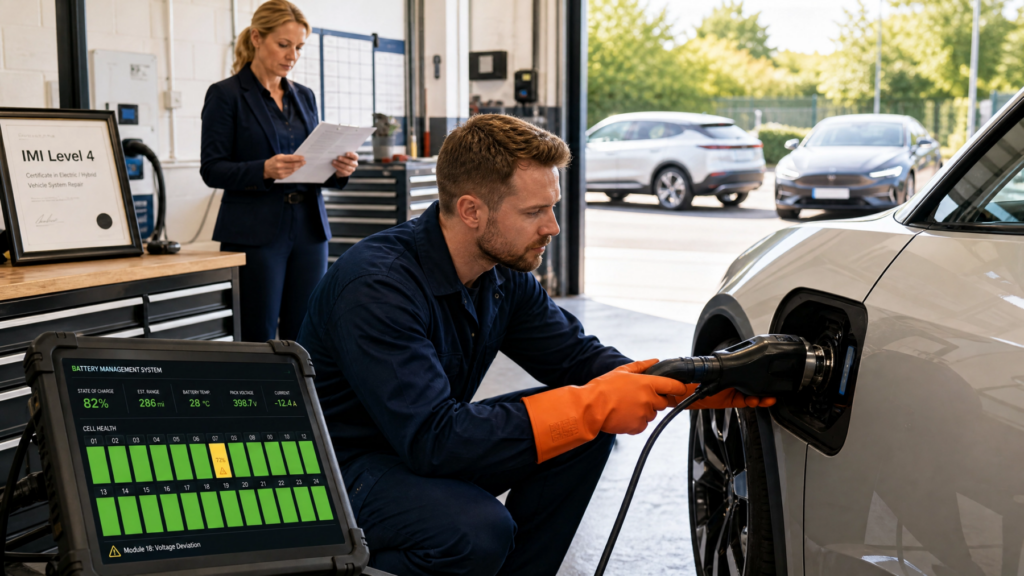
The area where Chinese manufacturers have the most work to do in the UK is aftermarket support. A vehicle that cannot be reliably serviced, diagnosed and repaired is a vehicle that will struggle to build long-term consumer confidence. That means technician training programmes, accessible technical information, diagnostic tool compatibility with independent workshops, spare parts availability and genuine engagement with the UK’s existing repair infrastructure.
Some manufacturers are beginning to address this. But the gap between vehicle sales growth and aftermarket infrastructure development remains meaningful. A successful automotive brand needs an ecosystem capable of maintaining its vehicles throughout their working lives and building that ecosystem in a new market takes time, investment and genuine collaboration with training bodies, independent garages and the technicians who keep these vehicles on the road.
12. What Chinese EV growth means for UK technicians
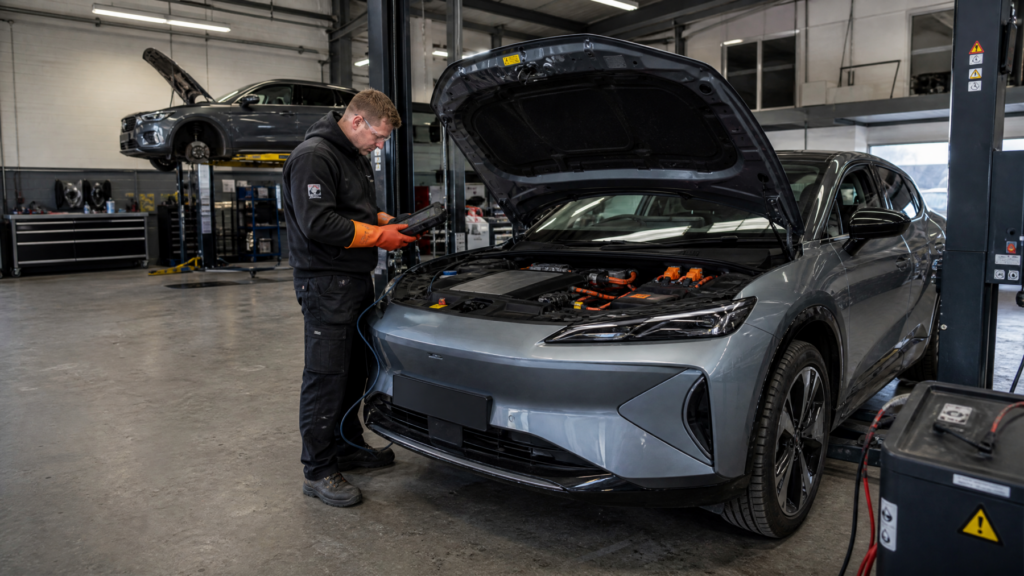
Brand-neutral skills will become more important as the fleet diversifies
As Chinese EVs age and move out of manufacturer warranty, independent garages will encounter them with increasing frequency. The technical demands they present are not fundamentally different from those of other EVs: high-voltage safety, battery diagnostics, thermal management and software-based fault finding are all relevant regardless of the badge on the bonnet. What changes is the specific diagnostic tooling, software access and technical documentation available for each brand.
This reinforces the value of brand-neutral EV skills. IMI qualifications at Level 3 and Level 4 provide a foundation that applies across manufacturers. Technicians who combine that qualification framework with genuine diagnostic depth and continuous learning are well positioned to service a UK EV fleet that is becoming more diverse, not less.
13. Building the car is only half the story
What comes after the sale will define long-term success in the UK
China’s EV success resulted from long-term investment across batteries, raw material processing, manufacturing, technology, infrastructure and supply chains. The scale of what has been built is genuinely significant and its effects on the global automotive industry are already substantial.
The next challenge for Chinese manufacturers in markets such as the UK is ensuring that the technical knowledge, parts availability, training and repair capability required to maintain their vehicles develop at the same pace as vehicle sales. The cars have arrived. The ecosystem to support them through a full ownership lifetime is still catching up and how quickly that gap closes will shape how Chinese EVs are perceived in the UK for years to come.
Sources: CSIS/Bloomberg June 2024, SNE Research February 2026, Auto Trader Road to 2030 Report January 2025, Regit February 2026, Indicata/Carscoops May 2026, BYD Europe technical documentation, evbattery.us June 2026, ALJ Perspective, Fleet News. All figures verified at time of publication.