
No shortcuts in high voltage: The risks of fast-tracking level 4 EV qualifications
1. Introduction
Picture a busy independent garage in the Midlands. A technician, newly certified at Level 4 after a five-week intensive course, is tasked with diagnosing a fault on a customer’s electric vehicle. He has passed his assessment. He has a certificate. But when faced with a live high-voltage system and an unfamiliar fault code, something he never encountered during his compressed training, he is not sure where to begin. This is not a rare scenario. It is becoming more common as the industry scrambles to produce EV-qualified technicians faster than the training infrastructure was ever designed to allow.
The growth of the electric vehicle market in the UK has been rapid. According to the Society of Motor Manufacturers and Traders, battery electric vehicles accounted for nearly one in five new car registrations in 2024 and that share continues to grow. The government’s Zero Emission Vehicle mandate requires 80 per cent of new car sales to be electric by 2030, placing real pressure on the automotive workforce to upskill at pace.
The IMI Level 4 Award in Electric and Hybrid Vehicle System Repair and Replace represents the highest standard of working competency for technicians in this field. It is the qualification that employers and customers should be able to trust. The concern addressed in this article is a straightforward one: fast-tracking technicians to Level 4 without proper foundational training is a safety and capability problem that the industry needs to take seriously.
2. Understanding level 4 EV qualifications
What the qualification actually requires
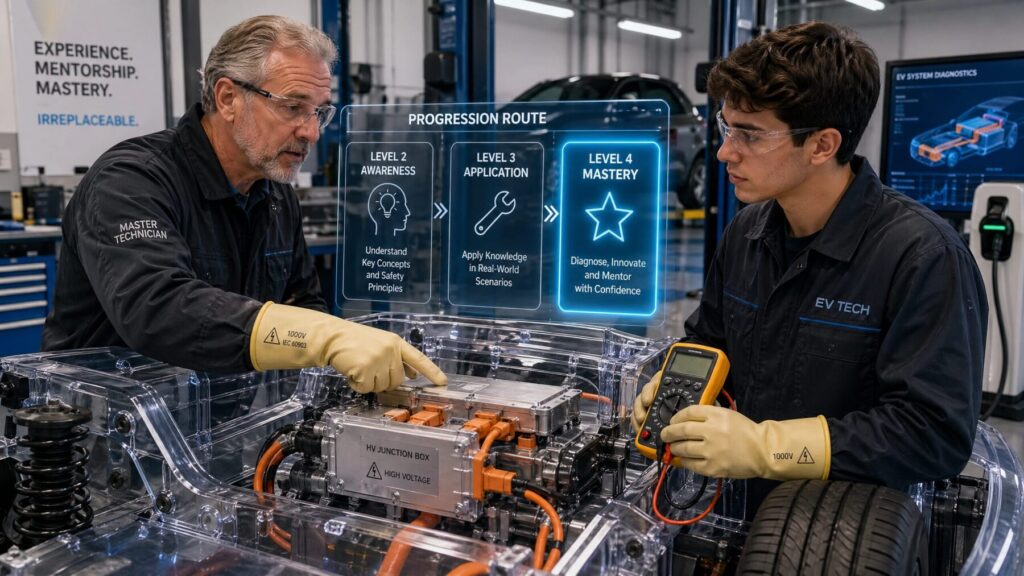
The IMI’s EV qualification framework moves through Levels 2, 3 and 4, each stage built deliberately on the one before it. Level 2 provides technicians with an awareness of electric and hybrid systems, introduces basic safety protocols and explains how high-voltage architecture differs from conventional vehicles. Level 3 moves into practical application, covering isolation procedures, routine maintenance and a deeper understanding of system components.
Level 4 is where genuine diagnostic and repair competency sits. At this level, technicians are expected to safely isolate and work within live or de-energised high-voltage systems, carry out complex fault-finding, interpret diagnostic data from battery management systems and undertake component-level repairs. The voltage levels involved in modern electric vehicles typically range from 400 to 800 volts DC, with some platforms exceeding this. The consequences of an error at this level extend well beyond a failed repair.
The IMI standards exist to codify what safe competence looks like at each stage of progression. They give employers, insurers and customers a recognised benchmark they can rely upon. When that progression is skipped or compressed, the qualification loses its meaning as a guarantee of genuine capability.
“IMI guidance is clear that Level 4 technicians must demonstrate both theoretical knowledge and verified practical competency before being certified to work unsupervised on high-voltage systems.”
3. The rise of fast-track programmes
Why they exist and what they look like
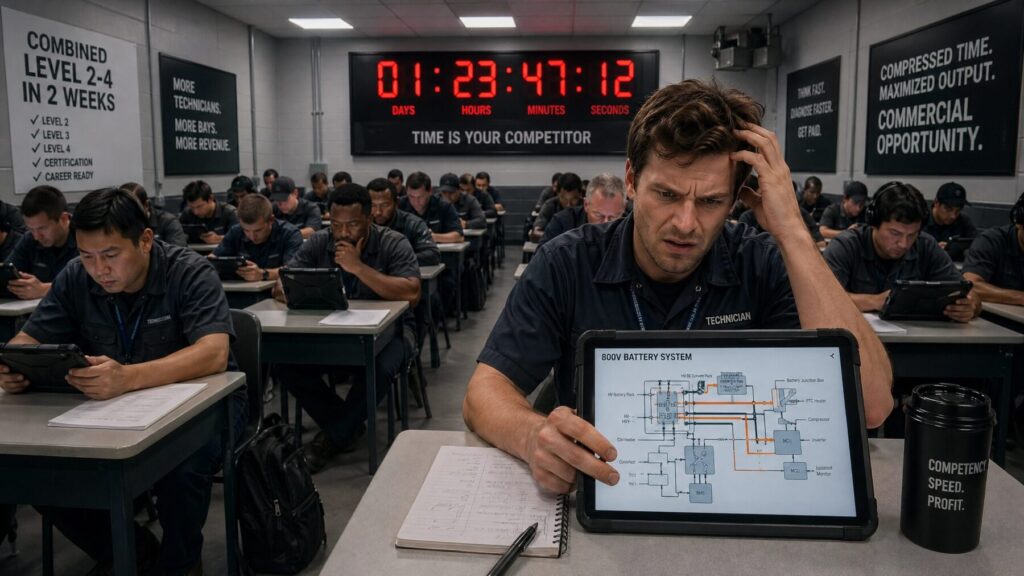
The skills shortage in automotive is well-documented. An IMI report published in 2023 estimated that the UK would require over 90,000 additional EV-trained technicians by 2031 to meet consumer demand. Against that backdrop, it is easy to understand why fast-track training routes have appeared. Training providers have identified a commercial opportunity. Employers see a quick solution to an immediate staffing problem. Technicians see a shorter path to higher-value work.
In practice, many fast-track Level 4 programmes compress what should be a carefully staged journey of several months into intensive blocks lasting just a few weeks. Some providers offer combined Level 2 to Level 4 packages delivered in a single sitting, with no meaningful gap between modules for knowledge to bed in. Others offer predominantly distance-based routes with limited hands-on practical content, relying on brief assessments to confirm a competency that may never have been properly developed.
For an experienced technician with many years of hands-on automotive work already behind them, a more efficient pathway to EV qualification can be reasonable, provided the foundational knowledge is genuinely in place and properly assessed. The problem arises when fast-track routes are taken by individuals whose prior experience does not adequately prepare them for high-voltage work and when employers accept certificates without scrutinising the quality of training behind them.
4. The risks of fast-tracking
Safety, knowledge gaps and employer liability
High-voltage work requires a level of care and precision that conventional automotive repair does not. A technician who misidentifies a live circuit, skips an isolation step or misreads a battery fault code is not simply at risk of completing a poor repair. They are at risk of serious injury and so are the colleagues working nearby. The customer driving away in that vehicle afterwards faces risk too.
Knowledge gaps caused by rushed training are not always visible on the surface. A technician may pass an assessment without fully understanding the principles behind their answers. They may know the correct procedure for safe isolation without truly grasping what happens when that procedure is not followed correctly or why each step exists in the first place. In the day-to-day workshop environment, this shallow competency can go unnoticed until something goes wrong.
Fault isolation in electric vehicle systems is a particularly demanding skill that takes time to develop properly. Identifying whether a performance issue lies in the battery management system, the power electronics, the thermal management circuit or the drive unit requires a structured diagnostic approach that cannot be taught adequately in a compressed timeframe. Technicians who have not built this thinking through proper, progressive training are more likely to misdiagnose faults, replace parts unnecessarily, or work on systems they do not fully understand.
For employers, the consequences reach further than individual incidents. A single workshop accident connected to inadequate technician training can result in Health and Safety Executive enforcement action, serious reputational damage and insurance complications. The effect on staff retention should not be underestimated either. Technicians who feel underprepared and unsupported in demanding, high-risk work are far more likely to leave the industry altogether.
5. Competence through structured learning
Why the progression route exists
The IMI’s tiered qualification structure is not administrative caution. It reflects a genuine understanding of how technical competency develops in practice. Level 2 provides the conceptual framework. Level 3 begins to translate that understanding into real workshop skills. Level 4 refines those skills into expert diagnostic and repair capability. Each stage depends on the one before it, not only in terms of knowledge, but in terms of professional judgement and safe working habits.
Practical, workshop-based experience is irreplaceable in this process. A technician who progresses through Level 2 whilst working alongside experienced colleagues learns not just what to do, but how to approach high-voltage systems with the right mindset: methodical, careful and never complacent. That professional culture cannot be absorbed during a brief practical session at the end of an intensive course.
Mentorship and supervision are central to how real competency develops. The most effective training environments pair developing EV technicians with experienced practitioners who can model good practice, spot emerging gaps in understanding and step in before poor habits become established. This takes time, but it produces technicians who are genuinely capable rather than simply certificated.
6. Recommendations for Employers and Technicians
Planning workforce development properly
For employers, the temptation to fill EV capability gaps as quickly as possible is understandable. However, it is worth weighing the total cost of a poorly prepared technician against the investment required for structured development. Verifying IMI-certified qualifications should be standard practice during recruitment and that means looking beyond the certificate itself. Employers should understand where and how training was completed, how many practical hours were involved and whether the candidate can demonstrate the kind of diagnostic reasoning that Level 4 genuinely demands.
Workforce development planning should map training progression against realistic business timelines rather than reacting to immediate pressures. A technician enrolled on a structured Level 2 programme today becomes a capable asset within a defined and manageable timeframe. A technician rushed to Level 4 without adequate foundations represents both a capability risk and a safety liability.
For technicians, the longer route is ultimately the more rewarding one. The confidence that comes from properly understanding the systems you work on, rather than having learned just enough to pass an assessment, is what builds a lasting and respected career. The EV sector will only grow and those with real competency at Level 4 will be in strong demand for many years to come.
7. Conclusion
The electric vehicle revolution is one of the most significant shifts the automotive industry has experienced and the technicians who underpin it deserve training that genuinely prepares them for the work involved. Fast-tracking Level 4 qualifications may appear to solve a short-term staffing problem, but it introduces risks to safety, to competency and to the long-term health of the workforce that far outweigh any short-term convenience.
Safety and competence cannot be rushed. The IMI qualification framework exists because the people who developed it understood this clearly. Employers, training providers and technicians all have a part to play in upholding those standards rather than finding ways around them.
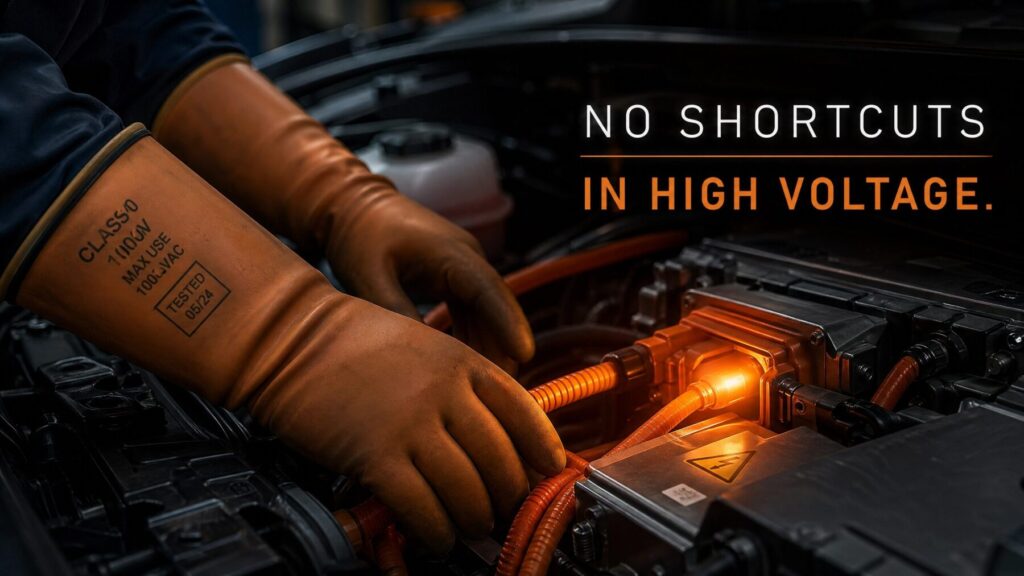
The message is simple. Invest in structured progression. Verify qualifications properly. Resist the shortcut. The voltage running through these systems is very real and so are the consequences of going into that work underprepared. There are no shortcuts in high voltage and there should not be.
Take action
Employers: plan your EV workforce development now, not when demand reaches crisis point. Training providers: uphold the integrity of structured progression. Technicians: build genuine competence. It is the foundation of a long and safe career in high-voltage work.