
Building EV Battery Repair Capability: The Skills and Recruitment Question
1. Introduction: The growing debate
A pattern that raises important questions
Walk through any EV-capable bodyshop or main dealer workshop in the UK today and you will notice something that would have seemed extraordinary a decade ago. Electric vehicles with relatively minor collision damage are being written off. Battery packs that may be partially functional are being condemned rather than assessed. Full replacements are signed off as the default, not the last resort.
The reasons are not hard to find. Insurers need predictability. OEMs carry warranty concerns. Workshops face time pressures that make complex diagnostic work commercially unattractive. Each factor is understandable in isolation.
But a harder question sits beneath the commercial logic. Is the prevalence of full battery replacement driven purely by economic modelling or does it also reflect a genuine capability gap in the current UK automotive workforce? Are we writing batteries off because repair is not viable or because too few people know how to carry it out safely and confidently?
This article explores the workforce and skills dimension of that question and what it means for recruitment, training and the long-term shape of the UK EV repair market.
2. The current landscape of EV battery decisions in the UK
Commercial logic and the case for replacement
The dominance of full battery pack replacement in current EV repair decisions is not irrational. It reflects a set of commercial and risk-based pressures that are very real for the businesses involved.
From an insurer’s perspective, the appeal of replacement over repair is straightforward. Replacement offers a known cost, a defined timeline and a clear warranty position. Repair, by contrast, introduces variables. How long will it take? Who will carry it out? What liability sits with the repairer if the battery subsequently degrades or fails? In a market where EV claims costs are already under scrutiny, predictability has genuine financial value.
For OEMs and franchised dealers, warranty considerations add another layer. Many manufacturer warranties do not recognise third-party battery repair, meaning any intervention at module or cell level can invalidate cover. The path of least resistance is a like-for-like replacement using approved parts.
Time is also a factor. Battery diagnostics at a meaningful depth take time. Workshop capacity is finite. A repair that requires a technician to spend several days on a single vehicle is commercially difficult to justify when a replacement can be processed within a predictable window.
None of this is unreasonable. The commercial logic is sound. However, there may be more behind these decisions than commercial efficiency alone.
The commercial case for battery replacement is well established. What is less examined is whether the industry currently has the capability to offer a genuine alternative at scale.
3. The capability question
Do we have the technicians who can actually do this work?
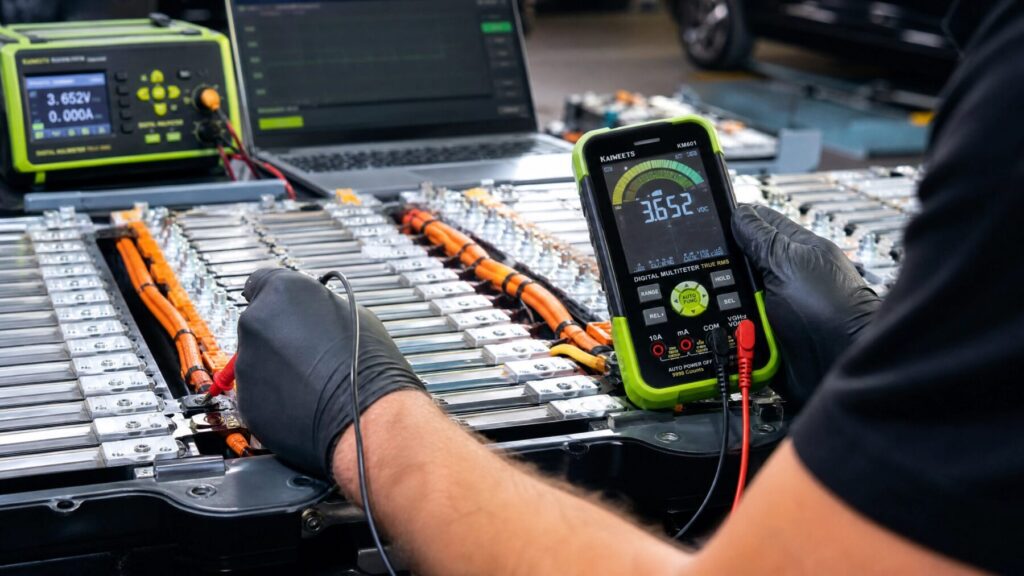
Ask directly: how many technicians working in the UK today are genuinely competent in high-voltage battery diagnostics, module-level repair and pack disassembly and reassembly? The honest answer is that nobody knows with confidence and that uncertainty is itself revealing.
The IMI’s Level 3 and Level 4 EV qualifications have grown significantly in uptake over the past three years. More technicians than ever hold a formal qualification that certifies their competency in high-voltage systems. This is genuinely positive progress. However, there is an important distinction between holding an IMI qualification and having regular, real-world exposure to advanced battery repair work.
A Level 4 technician who works primarily on EV servicing, routine faults and high-voltage safety isolation is doing valuable and skilled work. But that experience does not automatically produce a technician who is confident stripping a battery pack, identifying a degraded module, replacing it, reassembling the pack and validating the repair against manufacturer specifications. These are different capabilities and the qualification framework does not always make that distinction clearly enough.
The ecosystem of genuine battery repair specialists in the UK remains limited. A small number of independents have built this capability deliberately and some larger bodyshop groups are beginning to invest. But at the scale required to shift the industry’s default from replacement to repair, the workforce is simply not there yet. The training infrastructure, the tooling investment and the commercial incentives have not aligned in a way that makes it accessible to the broader market.
4. The skills gap within the skills gap
The issue is not just numbers. It is depth
The automotive industry is already familiar with the narrative of an EV skills shortage. More technicians are needed, training must accelerate and the pipeline is too slow for the pace of EV adoption. All of this is true.
But the more specific challenge deserves its own framing. The gap is not simply that there are too few EV-trained technicians. It is that there are very few technicians with deep, practical confidence in controlled battery repair work. These are not the same problem and they do not have the same solution.
Structured battery repair pathways barely exist in the UK today. The IMI framework covers high-voltage competency but does not yet provide a defined route into cell and module-level repair as a recognised specialism. Training providers are beginning to develop content in this area, but provision is patchy and uptake is limited by a lack of commercial pull from employers.
Insurer behaviour reinforces this. When the dominant claims outcome is replacement, workshops have little financial reason to invest in the tooling, training or time required to develop repair capability. The incentive structure points in the wrong direction and the skills gap deepens as a result.
This reframes the conversation. Volume of trained technicians matters, but depth of capability in a specific and technically demanding area is the more pressing challenge right now.
5. The recruitment implications
What the capability question means for hiring and workforce planning
Recruitment patterns in the EV sector are beginning to reflect the capability question, even where employers have not explicitly framed it in those terms. Workshops and specialist operators that are serious about battery repair are finding that the standard recruitment process does not give them what they need.
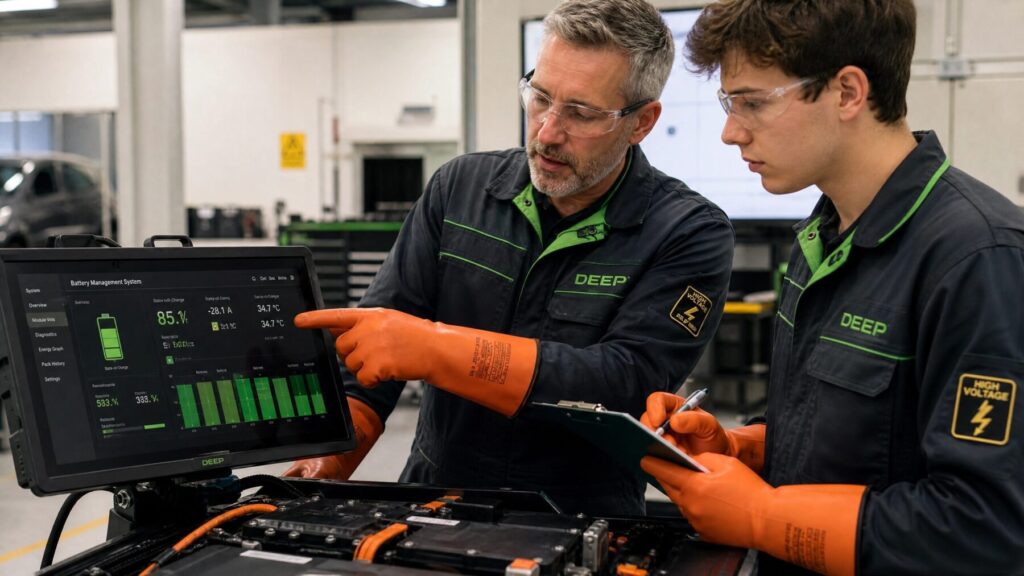
Advertising for an IMI Level 4 EV technician generates applications. Identifying which of those applicants has genuine hands-on battery repair experience, rather than a qualification gained primarily through theory and basic practical assessments, is a different challenge entirely. Certificates tell you that a technician has met a defined standard. They do not always tell you whether that technician has spent meaningful time inside a battery pack.
The technicians who combine solid electrical understanding, systematic diagnostic thinking and practical high-voltage safety experience are genuinely scarce. Those who have worked in environments where battery repair was actively encouraged, properly tooled and commercially supported are scarcer still. This combination carries real market value and forward-thinking businesses are beginning to recognise it as such.
There is also a structural opportunity here for independent workshops. Main dealers and large groups have the volume and the manufacturer relationships, but they are not always the environments where repair-first culture develops most naturally. Independents with a clear commitment to battery repair as a service offering are attracting a particular type of technician: one who wants to develop genuine technical depth rather than process high volumes of routine work.
Recruitment in this space is increasingly a reflection of what a business can genuinely offer. The workshops building real battery repair capability are creating the conditions that attract the technicians most likely to sustain it.
6. Strategic questions for the industry
The questions worth asking before the market forces the answer
The current landscape raises questions that the industry has not yet answered in any coordinated way. The longer they remain open, the more the default position of replacement becomes entrenched.
Should insurers develop incentive structures that reward repair over replacement? The sustainability argument is compelling. A battery that can be repaired and returned to safe operation represents a better outcome for the environment, for the customer and arguably for the long-term economics of the claims market. But insurers will need evidence of consistent repair quality and reliable outcomes before they shift their modelling, which requires the capability to exist first.
Are OEM warranty policies, however commercially understandable, actively slowing the development of repair capability across the broader market? If third-party repair automatically voids manufacturer cover, the disincentive to invest in that capability is structural rather than incidental.
Should the IMI and other training bodies develop a formal, recognised battery repair specialism that sits above Level 4 as a defined pathway? Without a clear credential, employers cannot reliably identify capability and technicians have no defined career step to work towards.
Most fundamentally: is the industry building long-term sustainability in EV repair or optimising for short-term convenience? The two are not always compatible and the point at which that tension becomes commercially significant may arrive sooner than expected.

7. Conclusion: Where the market goes next
Replacement today, repair capability tomorrow
Full battery pack replacement is commercially logical in the current market. The insurer economics, the warranty frameworks and the time pressures all point in that direction and dismissing them as short-sighted misses the genuine complexity of the environment businesses are operating in.
But long-term sustainability in EV repair requires something the current market is not yet consistently delivering: real battery repair capability, built through investment in tooling, structured training pathways, targeted recruitment and deliberate workforce planning.
The businesses that are thinking seriously about battery repair capability today are not waiting for the market to move first. They are building the skills, the processes and the reputation that will define the next phase of UK EV servicing and repair.
The question is not whether repair capability will matter. The bigger concern is whether the industry will build this capability before demand forces change. The businesses asking that question now may well be the ones shaping what comes next.