Hiring IMI-qualified EV technicians in the UK: A recruitment guide for independent garages and EV service providers
1. Introduction
The UK automotive sector is in the middle of a structural shift. Electric vehicles are no longer a future consideration for workshops. They are already arriving on ramps, booking systems and service schedules across the country. As EV ownership increases, independent garages and EV service providers are facing a new operational reality that demands different skills, processes and safety standards.
For many businesses, the challenge is no longer whether to work on electric vehicles, but whether they have the right people in place to do so safely and competently. High-voltage systems introduce risks that do not exist in traditional internal combustion engine vehicles and these risks cannot be managed through informal experience alone. This has placed IMI-qualified EV technicians at the centre of workshop capability.
Independent garages are under particular pressure. Customers expect EV servicing to be available locally, insurers and regulators expect compliance and competition for qualified technicians continues to increase. At the same time, the supply of technicians with verified EV training has not kept pace with demand. Recruitment, once a reactive task, has become a strategic priority that directly affects safety, reputation and long-term viability.
Hiring the wrong technician, or assigning EV work without the appropriate qualification, exposes businesses to operational disruption, legal risk and potential harm to staff and customers. Conversely, recruiting IMI-qualified EV technicians allows workshops to expand services with confidence and build a sustainable EV offering.
This guide is designed to support independent garages and EV service providers navigating this challenge. It explains the current EV technician landscape in the UK, outlines what IMI qualifications actually represent and provides practical guidance on how to recruit, assess and retain the right EV talent for your business.
2. The UK EV technician landscape
The shift from ICE to EV servicing
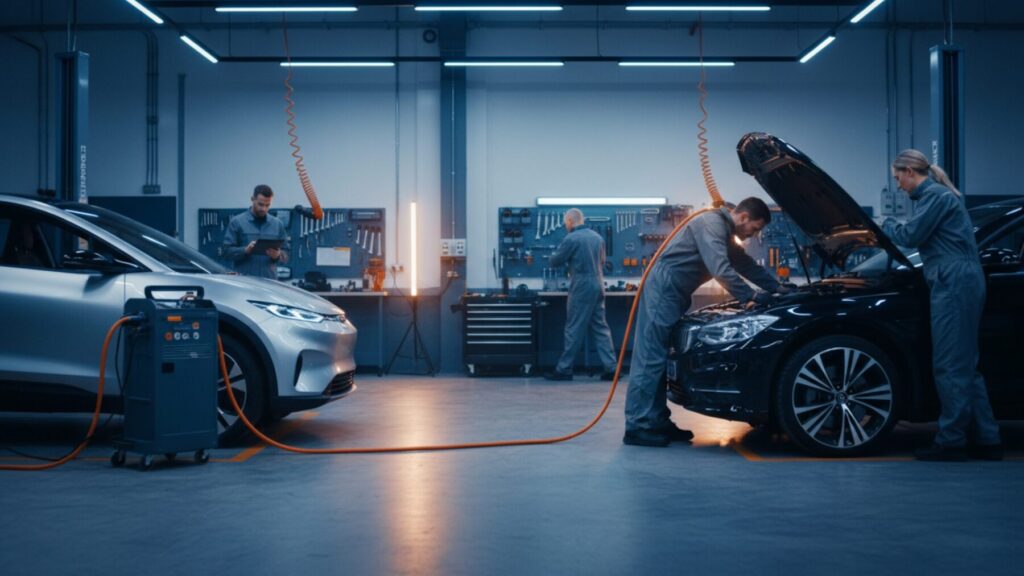
The growth of electric vehicle ownership in the UK has moved beyond early adoption. EVs and hybrids now form a consistent and growing part of everyday workshop demand. For independent garages and EV service providers, this has fundamentally changed the type of work being carried out on a daily basis.
Unlike internal combustion engine vehicles, EVs introduce high-voltage electrical systems, battery management technology and software-driven diagnostics. As EV volumes increase, workshops are handling mixed fleets where traditional mechanical work sits alongside high-voltage servicing. This creates new workload pressures, especially where technician capability is uneven or unclear.
Garages without sufficient EV-qualified staff often face delays, restricted job scope, or reliance on external support. Those with the right technicians can retain work in-house, improve turnaround times and offer customers a broader service range.
What does IMI-qualified mean?
In the UK, the Institute of the Motor Industry provides the recognised framework for EV and hybrid vehicle qualifications. IMI certification defines what level of work a technician is trained and authorised to carry out.
IMI Level 2 focuses on high-voltage safety awareness. Technicians at this level can work safely around EVs but are not permitted to carry out high-voltage repair tasks.
IMI Level 3 qualifies technicians to isolate systems and work on high-voltage components, including removal, replacement and recommissioning within defined procedures.
IMI Level 4 covers advanced diagnostics and complex system fault-finding, typically for senior technicians working at the highest technical level.
IMI qualifications matter because they provide a clear, nationally recognised standard for competence, safety and compliance.
- Improved safety awareness in high-voltage environments
- Compliance with UK health and safety expectations
- Consistent skill standards across workshops and technicians
Understanding this framework is essential when recruiting EV technicians, as it directly determines what work can be carried out safely and legally within your business.
3. Why IMI-qualified technicians matter
Technical competence and safety
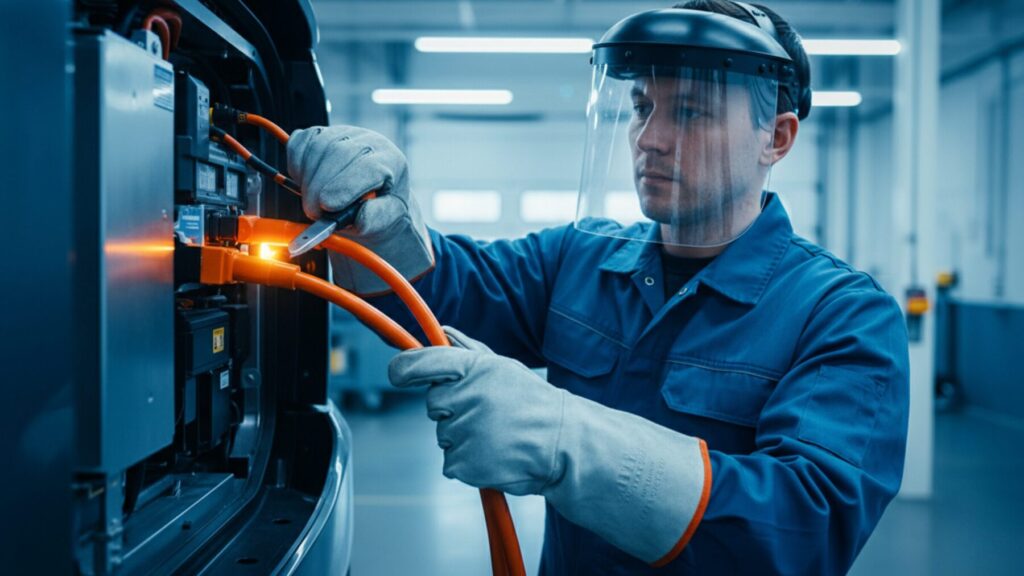
Electric vehicles introduce high-voltage systems that operate at levels capable of causing serious injury or fatal harm if handled incorrectly. Battery packs, inverters, charging systems and high-voltage cabling require controlled procedures, insulated tools and a clear understanding of isolation and verification processes. This level of risk makes informal experience or general mechanical knowledge insufficient for EV work.
Unqualified or incorrectly qualified work increases the likelihood of electrical shock, arc flash incidents, and damage to critical components. It also exposes businesses to secondary risks such as vehicle failures after repair and unsafe handovers to customers. In this environment, IMI qualifications serve as a clear and verifiable indicator of a technician’s competence to work safely within defined limits.
IMI-qualified technicians are trained to recognise hazards, follow structured processes and operate within their authorised scope. This reduces reliance on guesswork and ensures that EV work is carried out in line with recognised industry standards rather than improvised workshop practices.
Operational benefits
Beyond safety, IMI-qualified technicians deliver tangible operational advantages for independent garages and EV service providers.
- Reduced bottlenecks by enabling high-voltage work to be completed in-house
- Improved workshop throughput through clearer task allocation and fewer delays
- Greater consistency in diagnostics and repair outcomes
- Improved customer satisfaction through shorter turnaround times and fewer repeat visits
When technicians are qualified to the correct level, workshops can plan workloads more effectively and avoid situations where vehicles are left waiting due to capability gaps.
Commercial and legal importance
From a commercial perspective, IMI qualifications support compliance with UK health and safety obligations. Under the Health and Safety at Work Act, employers are required to ensure that staff are competent to carry out their duties safely. Assigning EV work to unqualified technicians can place businesses in breach of this duty.
Insurance providers also increasingly expect evidence of technician competence when underwriting workshop risk. In the event of an incident, the absence of appropriate qualifications can invalidate cover and expose businesses to significant financial liability.
Recruiting IMI-qualified technicians is therefore not just a technical decision, but a critical element of risk management, protecting people, reputation and long-term business stability.
4. Defining the ideal candidate profile
Skills and competencies to look for
An effective EV technician combines technical ability with disciplined working practices. On the technical side, this includes experience with diagnostics, fault-finding, system testing and, where applicable, high-voltage component removal and replacement. Familiarity with EV-specific tools, diagnostic software, and manufacturer procedures is increasingly important as systems become more complex.
Equally important are soft skills. EV work often requires structured problem-solving, clear documentation and confident communication with colleagues. Technicians must be able to explain findings accurately and follow procedures without deviation, particularly in safety-critical situations.
Qualification checklist
When assessing candidates, employers should look for clear evidence of competence rather than assumptions based on job titles.
- Verified IMI certificate level appropriate to the role
- Practical experience aligned with that qualification level
- Demonstrated understanding of high-voltage safety and compliance requirements
Matching qualification level to expected duties helps avoid risk and ensures work is carried out within authorised boundaries.
Cultural and workflow fit
Finally, the ideal candidate must fit the operational culture of the workshop. EV technology continues to evolve, so adaptability and willingness to learn are essential. Technicians who engage with training, updates and new systems are better suited to long-term roles.
Strong team communication also matters. EV servicing often involves coordination between technicians of different qualification levels, making cooperation and respect for scope critical. A continuous learning mindset ensures both safety and progression as the EV landscape develops.
5. Recruitment challenges for independent garages

Why EV technicians are hard to find
The demand for EV technicians in the UK has increased rapidly, but the supply of technicians with verified IMI qualifications has grown far more slowly. Training takes time and many technicians are still progressing through early EV qualification stages. This imbalance has created a competitive hiring environment where experienced EV technicians are in short supply.
Independent garages face additional pressure from manufacturer networks and main dealers, which often have larger training budgets, structured career paths and direct access to manufacturer-led EV programmes. As a result, independent businesses can struggle to attract technicians who already hold IMI Level 3 or Level 4 qualifications, particularly in high-demand regions.
Misaligned job descriptions
Another common challenge lies in how roles are advertised. Many job descriptions remain too broad, listing generic mechanical duties without clearly defining EV responsibilities. Others fail to specify the required IMI level or blur the boundaries between safety awareness and authorised high-voltage work.
A lack of clarity around safety expectations can deter qualified technicians, who are increasingly cautious about being asked to work beyond their certification. Ambiguous job adverts also attract unsuitable candidates, increasing screening time and slowing down the hiring process.
Internal hiring weaknesses
Independent garages often rely on informal or inconsistent recruitment practices, which can undermine the quality of hires.
- Unstructured screening that relies on CVs without qualification verification
- Limited interview processes that fail to assess EV competence
- No formal skills or safety assessment before offering the role
Without a structured approach, businesses risk hiring technicians who are not aligned with their operational needs or compliance requirements, leading to avoidable risk and turnover.
6. Designing an effective recruitment strategy
Write clear, targeted job descriptions
An effective recruitment strategy begins with a clear and accurate job description. This sets expectations for both employer and candidate and filters out unsuitable applications early.
Key elements to include:
- Required IMI qualification level
- Clearly defined EV and non-EV duties
- Safety expectations and high-voltage boundaries
- Tools, diagnostic systems and technology exposure
- Pay range, benefits and progression opportunities
Clear job descriptions signal professionalism and reassure qualified technicians that safety and scope are taken seriously.
Where to find IMI-qualified candidates
Finding EV-qualified technicians requires targeted sourcing rather than general advertising.
Specialist EV job boards and automotive recruitment platforms often attract candidates with relevant qualifications and experience. EV associations, training providers and IMI-accredited centres can also be valuable sources, particularly for technicians progressing through Level 2 and Level 3 qualifications.
Social media platforms and EV-focused forums allow businesses to engage directly with technicians, share opportunities and build visibility within the EV community. Consistent presence and clear messaging are key to building trust in these spaces.
Partnering with recruitment specialists
Many independent garages choose to work with recruitment partners who specialise in EV technicians. A specialist recruiter should understand IMI frameworks, safety requirements and the realities of workshop operations.
What to expect includes structured screening, qualification verification and candidate shortlists aligned with your needs. The main benefits are reduced hiring risk, faster access to qualified talent and greater confidence that candidates are suitable both technically and culturally.
For businesses scaling EV capability, specialist recruitment support can turn hiring from a reactive task into a controlled and repeatable process.
7. Screening and interviewing best practice
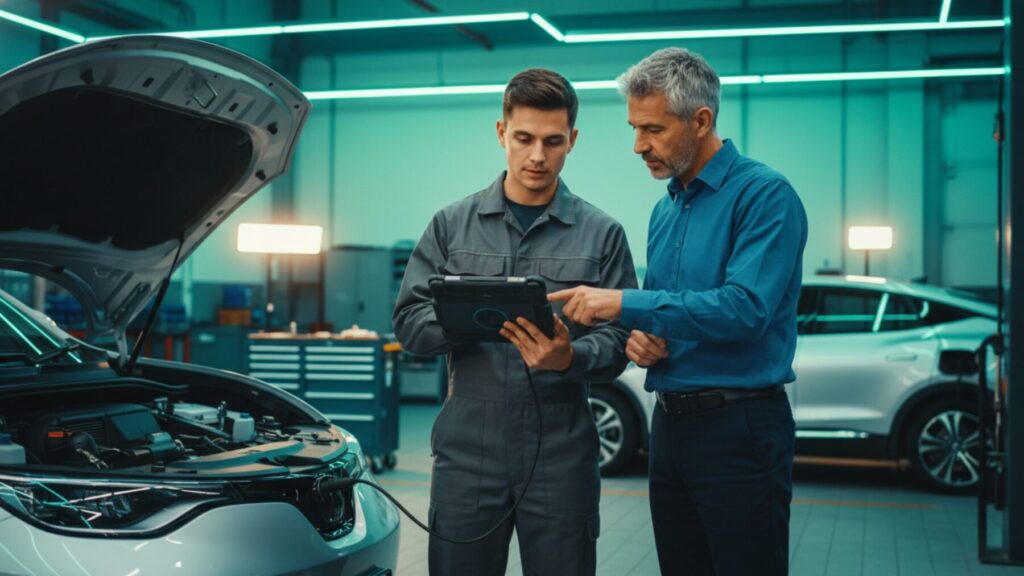
Recruiting EV technicians requires a more structured approach than traditional mechanical hiring. Qualifications alone are not enough. Employers must confirm competence, safety awareness and suitability for real workshop conditions.
Technical screening
Technical screening should begin before the interview and focus on verification rather than assumption.
IMI certificate verification
Confirm the technician’s IMI qualification level is valid, current and appropriate for the role. This ensures alignment with authorised EV duties and safety boundaries.
Practical work examples
Ask candidates to describe recent EV work they have completed, including isolation procedures, diagnostics, or component replacement. Look for clarity, structure and awareness of safety steps.
Diagnostic skill testing
Where possible, assess diagnostic reasoning through scenario-based questions. This helps identify whether a technician follows a structured approach rather than relying on trial-and-error methods.
Behavioural interviewing
EV work places strong emphasis on process and safety culture. Behavioral questions help identify how a technician operates under pressure.
Safety culture questions should explore how candidates handle risk, follow procedures and respond to uncertainty. Teamwork scenarios reveal whether a technician respects role boundaries and communicates effectively with colleagues of different qualification levels.
Problem resolution questions allow candidates to explain how they approach faults, unexpected issues, or conflicting information. Clear, methodical answers usually indicate reliable working habits.
Workshop trial or practical assessment
For senior or high-voltage roles, a practical assessment can add significant value.
Simulation tasks, such as fault-finding walkthroughs or isolation planning, demonstrate real-world thinking without exposing the workshop to risk. Supervisor evaluation during these trials provides insight into attention to detail, communication and adherence to procedure.
Time-limited exercises can also be useful, as they show how candidates prioritise safety and accuracy under realistic constraints.
8. Onboarding and retention strategies
Hiring the right technician is only the first step. Effective onboarding and retention are essential to protect your investment and maintain safe EV operations.
Structured onboarding checklist
A consistent onboarding process helps technicians integrate quickly and safely.
- Safety induction covering EV-specific risks and procedures
- Workflow process training aligned with workshop standards
- Tool, diagnostic system and equipment familiarisation
- Clear introduction to EV bays, exclusion zones and signage
This structure reduces early-stage errors and reinforces safety expectations from day one.
Ongoing training and development
EV technology evolves rapidly, making continuous development essential. IMI refreshers help technicians maintain competence and confidence, particularly as procedures and systems change.
Advanced EV system training supports progression for technicians moving toward higher responsibility roles. Where possible, manufacturer training partnerships can add value by exposing technicians to model-specific systems and emerging technology.
Investment in training also signals commitment, which improves engagement and loyalty.
Retention tactics
Retention is strongly linked to how technicians feel treated within the workshop.
- Clear recognition and progression paths tied to competence
- Fair and transparent reward systems
- A visible culture of respect, safety and professionalism
Technicians are more likely to stay where safety is prioritised, expectations are clear and skills are properly valued.
9. Conclusion
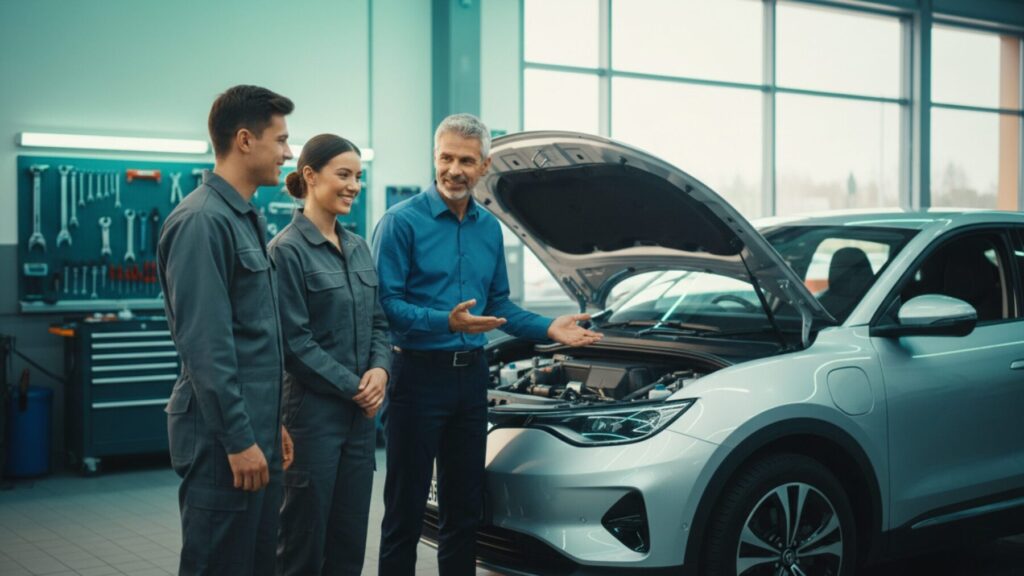
The future of EV talent in UK workshops
The transition to electric vehicles is reshaping the UK automotive sector at a pace that few independent garages or EV service providers can afford to ignore. As EVs become a permanent feature of everyday workshop demand, the ability to recruit and retain IMI-qualified technicians will increasingly define which businesses thrive and which struggle to keep up.
Getting recruitment right is not simply about filling vacancies. It is about protecting safety, maintaining compliance and building operational capability that can scale as EV volumes continue to grow. Technicians qualified to the correct IMI level allow workshops to manage high-voltage work confidently, reduce disruption and deliver consistent service standards to customers.
This guide has highlighted the importance of understanding the EV technician landscape, recognising what IMI qualifications represent and defining clear candidate requirements. It has also outlined the challenges independent garages face, alongside practical strategies for sourcing, screening and retaining EV talent. Structured recruitment, clear job definitions and investment in onboarding and development all contribute to stronger long-term outcomes.
For workshop owners and service providers, the next step is to review current capability honestly and identify gaps before they become constraints. For those planning to expand EV services, proactive recruitment and clear safety-led processes will provide a competitive advantage.
By taking a considered and informed approach to hiring IMI-qualified EV technicians, UK workshops can build resilient teams that support safe operations, customer confidence and sustainable growth in an increasingly electric future.