The critical role of PPE in the EV technician workforce
1. Introduction: High voltage, high stakes
Think about the most valuable assets in your workshop right now. They are not the latest diagnostic tablets or high-power vehicle chargers. They are the technicians standing in front of 800V battery packs, the individuals who possess the IMI Level 2 to 4 certifications required to perform complex live work. In the current UK market, these technicians are rare and highly valuable resources.
The UK EV market is expanding rapidly, with battery electric vehicle sales reaching record highs quarter after quarter. Yet there remains a critical shortage of qualified, IMI-certified technicians capable of servicing them. These shortages are most acute across IMI Level 2 to Level 4, where demand for repairs and maintenance continues to outpace the output of training providers.
This scarcity makes retaining and protecting skilled technicians more vital than ever. When your workforce is this difficult to replace, their physical safety becomes the cornerstone of business continuity. With demand for qualified IMI Level 2 to Level 4 EV technicians far exceeding supply, the UK’s ability to safely maintain and repair electric vehicles depends not only on skills but on an employer’s commitment to proper PPE and workplace safety.
If you fail to protect them, you are not just risking a safety incident; you are risking the complete loss of your EV service capability.
2. Understanding the unique risks of EV powertrains
To manage an electric vehicle workforce, you must first respect the technical nature of the hazards involved. Unlike traditional combustion engines, where a fuel leak is visible and a hot manifold follows predictable thermal patterns, the energy stored in an EV powertrain is silent and requires specialised detection. We are dealing with DC voltages that can exceed 800 volts in many modern performance models. At these levels, electricity can bridge gaps through air ionisation, potentially causing catastrophic injuries without any direct physical contact.
Even highly trained IMI Level 2 to Level 4 EV technicians face significant hazards without the correct PPE, because training and equipment must work together to mitigate risk. Training provides the mental roadmap for safety, but PPE is the physical barrier that stops a mistake from becoming a fatality. The risks associated with these powertrains include:
Muscular contraction hazards: Sustained DC current can cause involuntary muscle contraction. This may prevent a technician from releasing a live component, leading to prolonged exposure that is often fatal.
Residual energy storage: High-capacity capacitors within the inverter system can maintain a lethal charge for a designated period, even after the main battery has been isolated.
Thermal and chemical exposure: A short circuit can trigger an instantaneous release of extreme thermal energy, capable of causing catastrophic injury within milliseconds. Damaged battery cells may also leak corrosive electrolytes that immediately compromise standard workshop materials.
The human element: Even the most experienced IMI Level 4 technician can experience a momentary lapse in concentration. Knowledge provides the methodology, but professional-grade PPE provides the fail-safe. When you provide the correct equipment, you demonstrate that safety protocols are the absolute priority over the speed of the job.
3. What “correct PPE” means for EV technicians
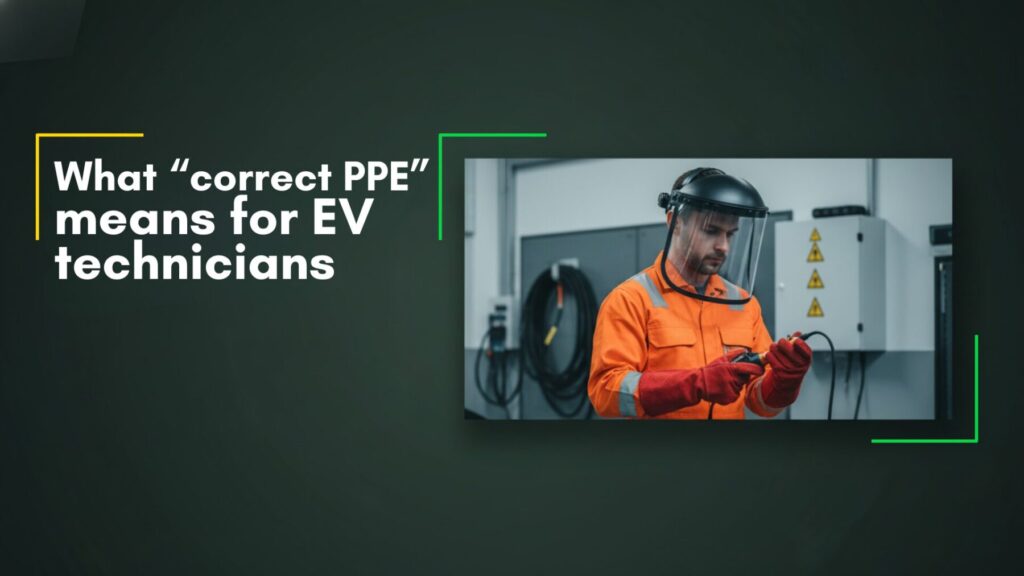
In a general workshop setting, PPE might mean basic boots and latex gloves. In an EV environment, the definition of ‘correct’ is rigorous, highly technical, and mandatory for operational safety. When you are hiring IMI-qualified technicians, those individuals expect you to provide PPE that matches their skill level. Higher-rated PPE is required for Level 4 specialisms where live work or deep diagnostics are performed.
Correct PPE for a high-voltage environment includes several layers of protection:
Electrical insulating gloves (Class 0): These must be specifically rated for work up to 1000V. They should be personal issues to ensure integrity and hygiene. Your technicians must perform a manual air leak test before every single use to identify micro punctures that could prove fatal.
Arc flash protection: This includes flame-resistant overalls and face shields tested to withstand specific incident energy levels. Standard synthetic workwear is a significant hazard as it can melt onto the skin when exposed to the high temperatures of an electrical arc.
VDE certified insulated tools: Every component, from wrenches to pliers, used in the high voltage bay, must be rated for 1000V insulation. Using uninsulated metal tools in an EV bay represents a fundamental failure in safety management and will immediately alienate your senior staff.
Voltage testing equipment: Only high-quality, calibrated two-pole voltage testers should be used to “prove dead.” A technician’s safety relies entirely on the accuracy and reliability of these measurement tools.
Beyond the hardware, “correct” means accessibility. If a technician has to search the building for a face shield, your workflow is flawed, and you are incentivising shortcuts. Providing high-tier equipment signals that you recognise the high level of technicality in their role and that you are equipped for high-tech maintenance.
4. Qualification without protection: A dangerous gap
We often see businesses invest thousands of pounds in IMI training for their staff, only to return them to a workshop environment that lacks the necessary infrastructure and gear. This creates a significant and dangerous gap between theoretical training and practical safety. Because IMI Level 2 to Level 4 certified technicians are in short supply, you cannot afford to lose them due to poor safety provisions.
An IMI Level 4 technician is fully aware of the potential consequences of 800V exposure. Returning to find substandard equipment leads to decreased job satisfaction and immediate turnover. In a competitive labour market where IMI Level 2 to Level 4 EV technicians are scarce, employers that fail to provide adequate PPE risk losing talent. Qualified technicians increasingly choose employers who demonstrate a genuine commitment to safety, including the provision and maintenance of correct PPE.
Consider the current market dynamics:
- Many technicians have multiple job offers on the table at any given time.
- Your safety standards are often the deciding factor for a candidate.
- A technician will choose a workplace that values their life over a workplace that offers a slightly higher salary but expects them to cut corners.
- If a technician feels forced to bypass protocols due to a lack of PPE, they will seek employment where professional standards are upheld.
5. Employer responsibility: Legal, moral and operational
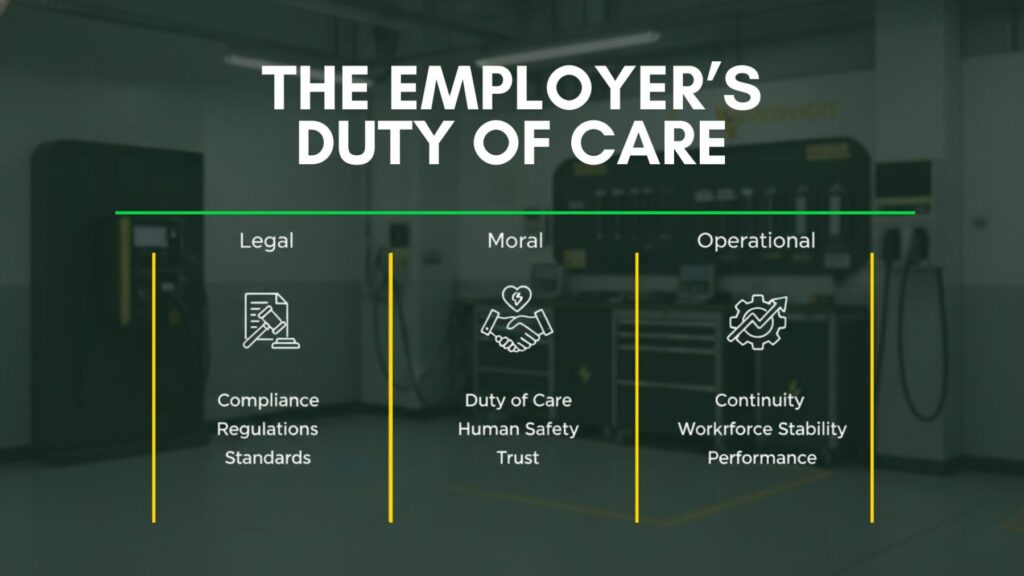
As an employer, your responsibility is structured across three main pillars. Compliance is about protecting the viability of your business as much as it is about protecting your people. Reiterate to your leadership that compliance isn’t just a legal burden; it’s a strategic business imperative when skills are scarce.
Legal responsibility: You are bound by the Health and Safety at Work etc. Act 1974 and the Electricity at Work Regulations 1989. These laws require that you provide a safe system of work. Failure to do so can lead to HSE enforcement notices, heavy fines, or even criminal prosecution in the event of an incident.
Moral responsibility: Assigning staff to 800V systems without the highest grade of protection is an ethical failure. The psychological security provided by proper equipment reduces stress and improves technical accuracy on the job.
Operational responsibility: The loss of a single specialised technician can bring your entire EV service line to a halt. Redundancy in safety prevents the loss of your most valuable human assets. Employers who neglect PPE not only risk injury but also reduce their attractiveness to qualified IMI technicians. With a shortage of IMI Level 2 to Level 4 technicians, compliance with PPE regulations is also a competitive advantage in recruitment. It demonstrates that your business is managed with foresight and professional respect.
6. PPE as a workforce retention and recruitment tool
With the UK EV skills gap widening, retention is becoming your most critical challenge. Recent data suggests that over 40% of automotive businesses are struggling to find qualified EV staff, and vacancies for IMI Level 2 to Level 4 technicians are rising faster than training output.
Modern candidates prioritise safety infrastructure. They frequently ask about PPE budgets, glove testing intervals, and tool kit ownership during the interview process. Salary alone does not attract these technicians; a professional safety culture does. Technicians will often choose a slightly lower salary if they feel significantly safer in your workshop.
Key recruitment and retention points:
Retention impact: Technicians leave roles where PPE is poor, communal, or outdated.
Recruitment conversations: Candidates now ask about PPE provision early in interviews. If you cannot show them a dedicated EV bay with proper equipment, you will lose them.
Specialist perspective: In conversations with IMI Level 2 to Level 4 technicians, we find that safety and PPE provision now feature as key factors in employment decisions, second only to base salary.
Employers who ignore this risk slower hiring, higher turnover, and reduced productivity. You must view your safety equipment as a high-performance recruitment tool that validates your brand.
7. Building a safety-first EV workplace culture
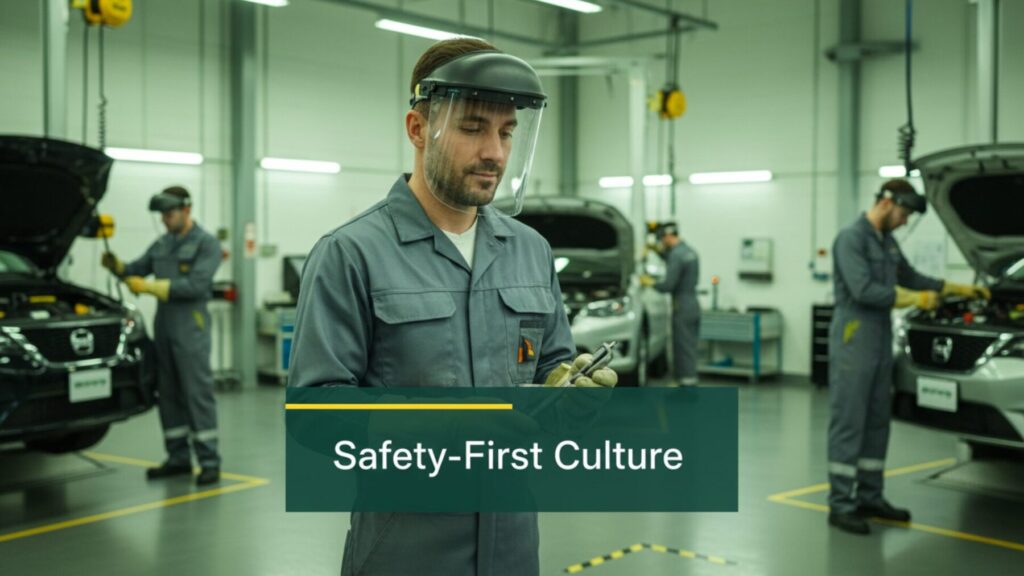
A culture of safety is established through consistent management and respect for technical protocols. Culture matters even more in a skills-tight market because technicians want workplaces that show respect for their expertise. A strong safety culture attracts and retains scarce IMI-qualified talent. Technicians talk, and reputations regarding safety spread quickly in the automotive community.
To build this culture, you should focus on:
- Professional recognition: Treat your Master Technicians as technical specialists whose safety requirements are non-negotiable.
- Protocol adherence: Reward the precise following of isolation procedures rather than prioritising the speed of the repair. Never incentivise a technician to “skip the gloves” to save five minutes.
- Collaborative safety: Consult with your technicians regarding equipment needs. They are the ones working inside battery packs and are best positioned to identify practical gaps.
- Visible standards: A well-organised, fully equipped EV bay serves as a visual testament to your commitment to excellence.
8. The role of recruitment in raising industry standards
As a specialist EV recruiter, we see first-hand how proper safety provisions, especially PPE, influence technician decisions. IMI Level 2 to Level 4 candidates are increasingly selective about employers’ safety practices, and we encourage employers to lead on PPE not just for legal compliance, but to attract and retain highly qualified technicians in a competitive market.
We act as the bridge between your workshop standards and the candidate’s expectations. When we represent a business that can demonstrate a clear commitment to EV safety, we find that the calibre of candidates we can attract is significantly higher. By making PPE a central part of your recruitment pitch, you are telling the market that you are a serious player in the EV space. Raising standards at the point of hire ensures the entire UK industry matures safely and remains viable for the long term.
9. Conclusion: Protecting people protects progress
The UK’s EV transition depends on both the skills and the safety of its technician workforce. By investing in proper PPE and a strong safety culture, particularly for IMI Level 2 to Level 4 certified technicians, you, as an employer, can protect your people, improve recruitment outcomes, and sustain the powertrain ecosystem of the future.
These technicians are the guardians of the electric powertrain. They are essential to the future of the automotive industry. Providing professional-grade PPE is a direct investment in staff loyalty and business continuity. The industry can only grow if the workforce remains safe and healthy. Prioritising safety will naturally attract the most skilled professionals to your business, creating an excellence magnet that your competitors cannot match. Protecting the individual is the foundation of your long-term operational success.