
Three-Quarters of UK Technicians Aren’t Qualified to Work on High-Voltage EV Systems. Here’s Why That Should Worry Everyone.
1. The clock is ticking and the workshops are not ready.
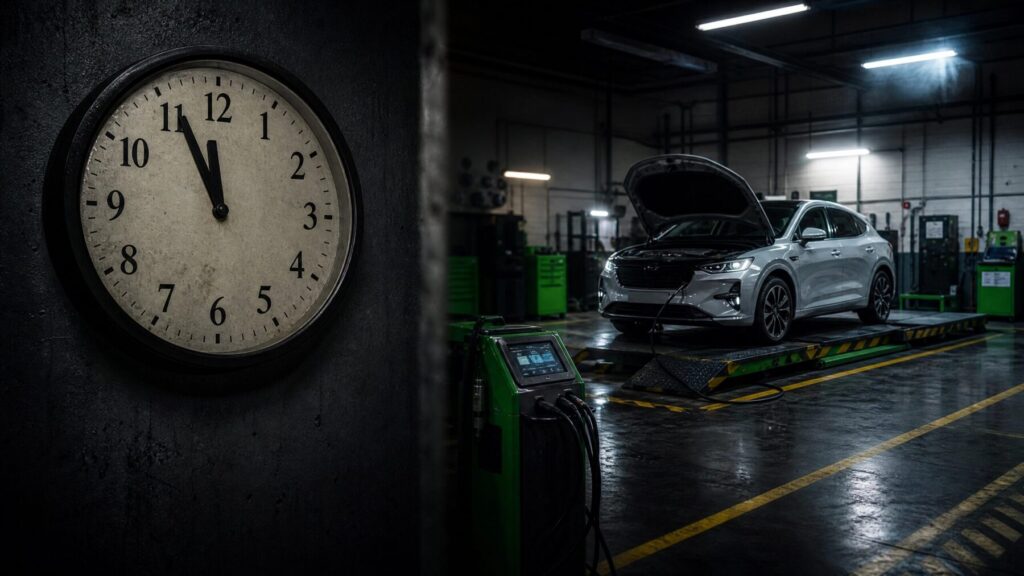
Britain is buying electric cars faster than it is training the people to fix them.
Picture this. Your electric vehicle develops a fault on a Tuesday morning. You ring your nearest garage. They cannot help you. Not because they are fully booked, not because they lack the right parts, but because they are safely unable to work on your vehicle. This is not a worst-case scenario invented to make a point. It is a reality that more EV owners in the UK are beginning to encounter.
According to the Institute of the Motor Industry, only 26% of the UK technician workforce was EV qualified at the end of the third quarter of 2025. That figure represents 71,942 technicians out of a total workforce that numbers well into the hundreds of thousands. 3 in every 4 technicians in Britain cannot reliably work on the vehicle the government is urging every driver to purchase.
At the same time, September 2025 delivered the highest volume of new car registrations the UK had seen since 2020, with electrified vehicles making up a significant majority of those sales. While the infrastructure to sell EVs is growing rapidly, the servicing network and the availability of qualified EV technicians across the country has not kept pace.
Only 26% of UK vehicle technicians are currently qualified to work on electric vehicles. The government’s 2030 ICE ban is 4 years away. Source: IMI TechSafe Q3 2025
2. Forty-four thousand technicians short by 2035
The numbers are stark and the trajectory is heading in the wrong direction
The scale of the problem becomes clearer when you look at the projections. IMI TechSafe data predicts that the shortfall of EV-qualified technicians will reach 3,000 by 2031 and 16,000 by 2035, based on earlier forecasts. More recent IMI analysis, published in early 2026, has revised that upper figure sharply upward, warning that projected demand could exceed supply by more than 44,000 technicians by 2035.
Even within the current period, the training pace is decelerating. The number of technicians gaining an EV qualification in the third quarter of 2025 dropped by nearly 13% compared to the first quarter of the same year. IMI analysis then predicted a further slowdown in the final quarter, with only around 2,580 new certifications expected.
Emma Carrigy, Head of Research, Policy and Inclusion at the IMI, put it plainly. The pace of training is misaligned with current and future demand and is likely to fall short of what is needed to support the UK’s Zero Emission Vehicle targets. The direction of travel is not ambiguous. EV sales are rising. Technician training is slowing. These two trends are on a collision course.
3. Where you live determines whether your EV gets fixed
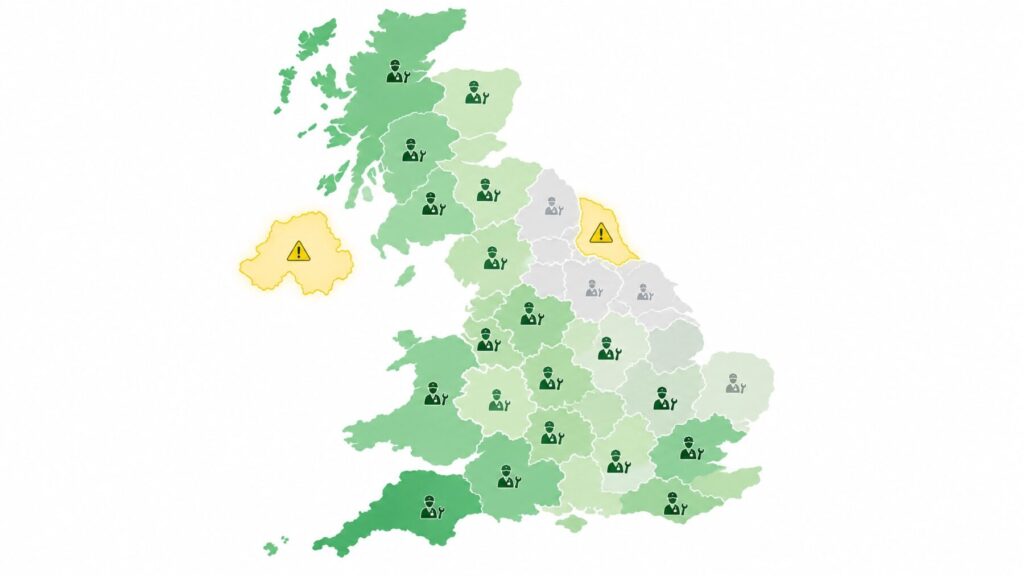
Skills are clustered in franchise dealers, leaving independent garages and rural drivers exposed
The shortage is not spread evenly. The distribution of EV-qualified technicians across the UK creates a situation that the IMI has described as a postcode lottery and the data behind that phrase is striking. The East of England has the highest rate of EV qualifications at 9.5% of its technician workforce. Northern Ireland sits at the bottom with just 3.7%. The North East stands at 4.4% and Yorkshire and the Humber at 5%.
London and the South East present a particular paradox. Both regions have higher concentrations of electric vehicles on their roads, yet only 6.1% of technicians in London and 6.4% in the South East hold EV qualifications. The areas with the most EVs are not the areas with the most people qualified to service them.
The concentration of skills within the franchise dealer market deepens the problem further. Independent workshops, which serve the majority of UK drivers, are the least equipped. They face the same training costs as larger operators but without the commercial volumes or financial backing to absorb them. As the second-hand EV market grows and more vehicles move out of manufacturer warranty and into the independent sector, this gap will become far more visible to everyday motorists.
The East of England has the highest rate of EV-qualified technicians in the UK at 9.5%. Northern Ireland has the lowest at just 3.7%. Source: IMI TechSafe
4. Mixed messages, financial pressure and a government that Is not listening
The reasons training is slowing are structural, not accidental
The IMI has been direct about where responsibility for the slowdown lies. Mixed messages from government about the future of electric motoring, combined with the economic pressures facing workshops, have collectively put the brakes on training investment. For a small independent garage operating on thin margins, releasing a technician for several weeks of IMI TechSafe certification training is a significant commitment with no guaranteed short-term return.
The broader policy picture compounds this. The IMI has stated publicly that the government is overlooking the automotive aftermarket’s contribution to the net-zero transition. Workforce development in automotive servicing and repair is absent from several key policy initiatives where it should be central. The sector that will keep millions of electric vehicles roadworthy over the next two decades is being treated as peripheral to the green agenda rather than essential to it.
Emma Carrigy of the IMI warned that it is now too late for even sustained growth in certification to fully close the gap before the 2030 petrol and diesel ban arrives. The most acute pressure on technician capacity falls in the years immediately before 2030, when the ZEV mandate requires a sharp increase in electric vehicle sales. That creates a narrow window for employers to scale training and that window will not stay open indefinitely.
5. Longer waits, fewer choices and eroding confidence
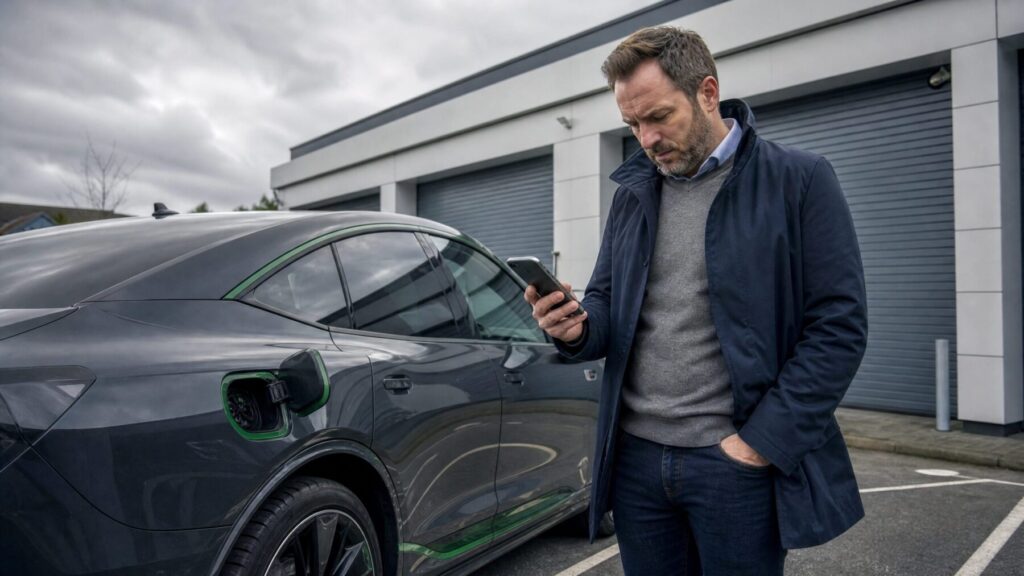
For the driver who has already switched to electric, the shortage is already a daily reality
The consequences for drivers are already materialising. EV owners in areas with low concentrations of qualified technicians are waiting longer for routine servicing and finding fewer garages capable of diagnosing faults safely. In rural communities, where the nearest franchise dealer may be a significant distance away, the practical difficulty of EV ownership is growing in ways that official adoption statistics do not capture.
Arthur Gribbin, engineering policy lead at Logistics UK, articulated the commercial dimension clearly. Every minute a vehicle is off the road costs operators money and commercial viability is the overriding factor that influences an organisation’s decision to invest in electric vehicles. For fleet operators already under cost pressure, a servicing network that cannot reliably support EV maintenance undermines the entire business case for electrification.
For private drivers, the impact is less immediately financial but no less real. A car that cannot be serviced locally or that faces extended waits for specialist attention, feeds a broader and damaging narrative that electric vehicles are not yet practical for ordinary life in Britain. Every avoidable delay and every turned-away customer makes the EV transition fractionally harder to sustain. That is a cost the whole industry and the country’s net-zero ambitions, ultimately bear.
6. What needs to happen
Training, investment and government action. All three are required, not one in isolation
The certification pathway for EV technicians is established and credible. The IMI TechSafe framework, supported by the Office for Zero Emission Vehicles, provides structured training in battery systems, thermal management and high-voltage safety procedures across Levels 2, 3 and 4. The qualification structure is sound. What is missing is the commercial incentive and government backing to deliver it at the scale the market now demands.
Independent workshops need financial support to release technicians for training without disrupting their daily operations. Targeted funding, whether through reformed apprenticeship levies, direct grants or government-backed training subsidies, would reduce the cost barrier that is currently deterring smaller operators from investing in EV capability. Without this, the skills gap will remain concentrated in the franchise sector while independent garages and the communities they serve, fall further behind.
The IMI’s position is unambiguous. A visible, qualified and geographically distributed service and repair workforce is a critical enabler of sustained EV adoption, not an optional feature of the transition. Recognising automotive servicing and repair as core EV infrastructure, rather than an afterthought to the manufacturing and sales agenda, is the policy shift that would make the most immediate practical difference.
7. Britain cannot go electric without the people who keep cars running
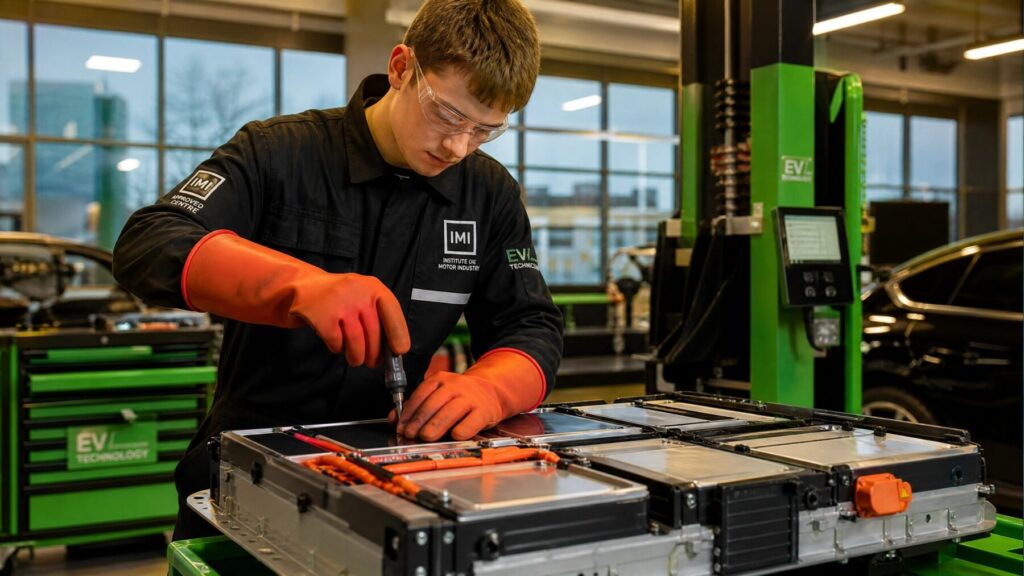
The transition is not just about what we drive. It is about who can fix it when something goes wrong.
Britain’s commitment to electric vehicles is set. The 2030 ICE ban approaches. ZEV mandate targets are shaping manufacturer strategy. Drivers are switching in growing numbers. But a transition that invests heavily in what sits on the forecourt while neglecting what happens in the workshop is built on an incomplete foundation.
The IMI has been consistent in its warning. Unless there is a significant acceleration in training, the gap between EV-qualified technicians and the number required will widen to a point where it actively impedes the transition rather than supporting it. The good news is that the problem is documented, the qualification framework exists and the solution is known. What remains is the political will and commercial urgency to act on it.
Britain is buying electric cars. It now needs, with equal commitment and at genuine pace, to train the people who will keep them on the road. The vehicles will not sell themselves into a future where nobody can fix them.
All statistics sourced from IMI TechSafe EV certification data, Q1 to Q3 2025, and IMI projections published February 2026. For technician training pathways and TechSafe certification, visit theimi.org.uk.