
Why cheap high-voltage EV tools are putting technicians and workshops at risk
1. Introduction
A risk nobody talks about loudly enough
A technician at a busy regional workshop powers up a cheap multimeter purchased online for a fraction of the cost of a branded equivalent. It carries a label suggesting it is rated for high-voltage use. Within moments of probing a battery circuit on an electric vehicle, the meter fails. The technician escapes injury by luck rather than by design. The incident goes unreported. The meter gets quietly replaced with another cheap one and the cycle continues.
This kind of near-miss is not as uncommon as the industry might like to believe. As electric vehicles become a mainstream part of UK motoring, the pressure on workshops to equip themselves quickly and cost-effectively has opened the door to a quietly growing problem: the use of cheap, uncertified or counterfeit high-voltage tools in environments where the margin for error is essentially zero.
This article examines why the quality of high-voltage tooling matters as much as technician skill, what the consequences of cutting corners can look like and what workshops should be doing right now to protect their staff, their customers and their business.
2. The rise of EVs and the demand for qualified technicians
A rapidly changing landscape
The UK electric vehicle market has grown at a pace that few predicted even five years ago. By early 2026, battery electric vehicles accounted for more than 20 per cent of new car registrations and the government’s Zero Emission Vehicle mandate is pushing manufacturers and consumers alike toward full electrification before the decade is out. The IMI has estimated that the UK will need well over 90,000 additional EV-trained technicians by 2031 to keep pace with demand.
Modern electric vehicles are not simply conventional cars with a battery fitted in place of a fuel tank. They are sophisticated systems in which high-voltage architecture, battery management software, thermal regulation circuits and regenerative braking all interact in ways that require a genuinely high level of technical understanding. Technicians working on these vehicles at IMI Level 3 and Level 4 carry significant responsibility, both for the quality of the repair and for the safety of everyone in the workshop.
What is sometimes overlooked in the conversation about skills and certification is the role that tooling plays. A qualified technician is only as effective and as safe as the equipment they are working with. Skill alone cannot compensate for a faulty insulated screwdriver, a multimeter that reads incorrectly or a battery tester that fails under load.
“The IMI estimates the UK needs more than 90,000 additional EV-trained technicians by 2031. The tools those technicians rely on must be fit for purpose from day one.”
3. What high-voltage tooling is and why it matters
More than just a set of spanners
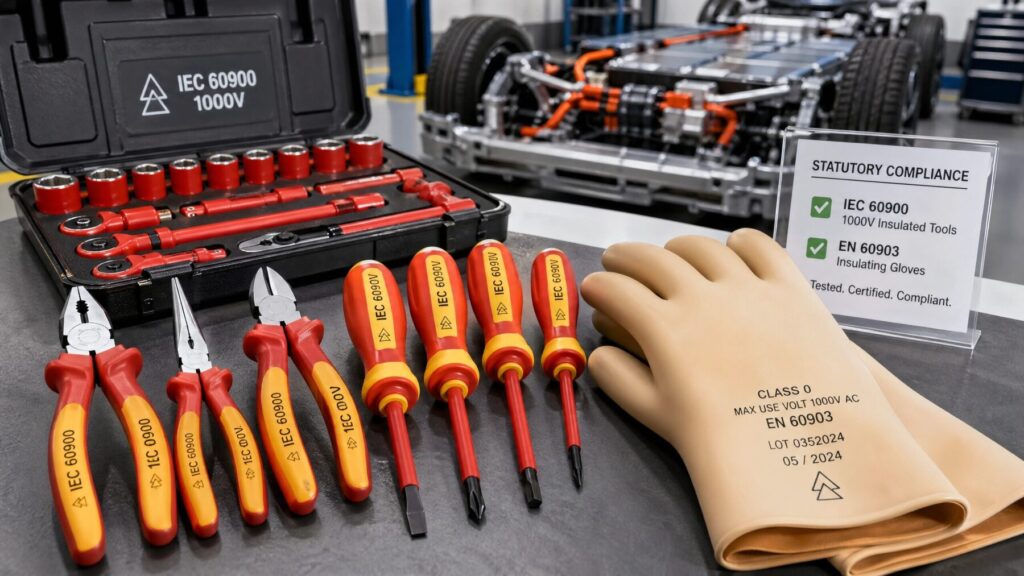
High-voltage tooling covers a broad range of equipment. It includes insulated hand tools rated to IEC 60900 standards, digital multimeters capable of safely measuring high DC voltages, battery cell testers, insulation resistance testers, HV-rated personal protective equipment including gloves rated to Class 0 or above and isolation devices. Each of these serves a specific protective function and each carries a certification requirement that reflects the conditions it is designed to withstand.
IEC 60900 is the international standard governing insulated tools used on or near live parts up to 1,000 volts AC and 1,500 volts DC. Tools that meet this standard undergo rigorous dielectric testing and are marked accordingly. Similarly, high-voltage gloves must meet EN 60903 and be regularly tested and re-certified to remain safe for use.
Proper tooling does three things simultaneously. It protects the technician from electrical shock. It protects the vehicle’s sensitive electronics from unintended current or incorrect readings. And it ensures that diagnostic results are accurate, which is the foundation of every repair decision that follows. Remove any one of those three functions and the entire process becomes unreliable.
4. The risk of cheap or knock-off tooling
When the saving is not worth it
The market for cheap high-voltage tools has grown significantly alongside the EV sector itself. Online platforms carry multimeters, insulated tool sets and battery testers at prices that appear attractive, particularly to smaller independent workshops operating on tight margins. Many of these products carry markings that suggest compliance with relevant standards. In practice, a significant proportion have never been independently tested and would fail to meet the requirements they claim to satisfy.
A 2023 investigation by a UK consumer electronics safety body found that a large proportion of multimeters tested from online marketplaces failed basic safety tests despite carrying CE or CAT rating markings. The consequences of using such equipment in an EV workshop can range from instrument failure and incorrect readings to arc flash incidents and electric shock.
Consider a scenario that reflects experiences shared informally across the industry. A workshop owner, under pressure to equip a new bay quickly, purchases an insulated tool kit from an unfamiliar online supplier at roughly a third of the cost of a certified equivalent. The tools look identical to the branded version. Within a few months, one of the screwdrivers develops a hairline crack in the insulation that is not visible to the naked eye. A technician using it on a live isolation point receives a shock significant enough to require hospital assessment. The workshop faces an HSE investigation, its insurance position is complicated and the technician is off work for several weeks.
This is not a hypothetical designed to frighten. It is a pattern that workplace safety professionals in the automotive sector are increasingly familiar with.
“A high proportion of multimeters sold online and claiming CAT III or CAT IV ratings have been found, on independent testing, to offer far lower protection than their labelling suggests.”
5. Why even highly skilled technicians are at risk
Qualification does not substitute for equipment quality
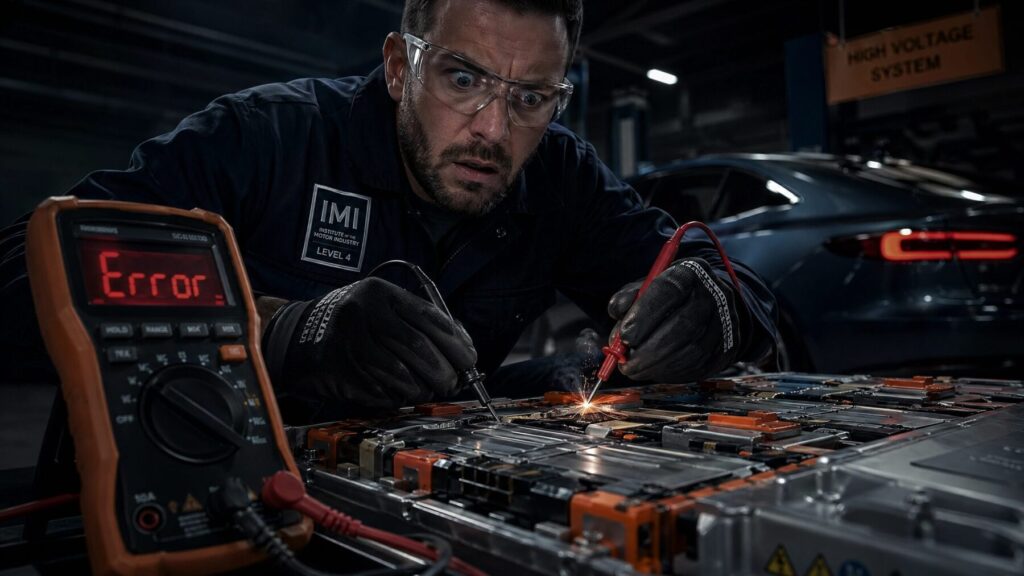
There is sometimes an assumption that a technician holding an IMI Level 4 qualification is well protected against workshop hazards by virtue of their training and knowledge. This is true to a point. Level 4 training instils the correct procedures, the right approach to isolation and a thorough understanding of safe working practice. What it cannot do is make a faulty tool perform correctly.
A Level 4 technician following every procedure to the letter, using a multimeter that reads 12 volts where the actual voltage is 400, is in danger regardless of their qualification. Their competence is being undermined by the equipment and they may not know it. This is precisely why the HSE guidance for high-voltage work in automotive settings specifies that tools must be appropriate for the task and verified as such, not simply assumed to be adequate because they carry a label.
The interplay between skill, certification and equipment quality is not a hierarchy in which skill sits at the top. All three components are load-bearing. Remove proper tooling from the equation and the entire structure becomes unsafe, regardless of how well-trained the person holding the tool happens to be.
6. Financial and operational implications for workshops
The true cost of a cheap tool
Workshop owners sometimes view tool quality as a question of personal preference or budget priority. The financial reality of a serious tooling-related incident tells a very different story. Direct costs following a workplace electrical accident can include HSE investigation fees, legal representation, compensation claims and increased insurance premiums. These figures alone can run into tens of thousands of pounds for even a single incident.
Beyond the immediate financial impact, there are operational consequences that compound over time. A workshop that suffers a serious safety incident faces scrutiny from customers, manufacturers and accreditation bodies. Reputational damage in the EV sector, where trust and certification matter enormously to consumers, can take years to recover from. Manufacturer-approved repairer status, where applicable, may be placed under review.
Skilled technicians are also acutely aware of the environment they are working in. Those trained to IMI Level 3 and Level 4 understand what safe working conditions look like. A workshop that cuts corners on tooling sends a clear signal about how it values its workforce. Retention of experienced EV technicians is already a challenge across the industry. Unsafe equipment accelerates the exit of exactly the people a workshop can least afford to lose.
7. Best practices for EV workshops
Building a safe and credible tooling standard
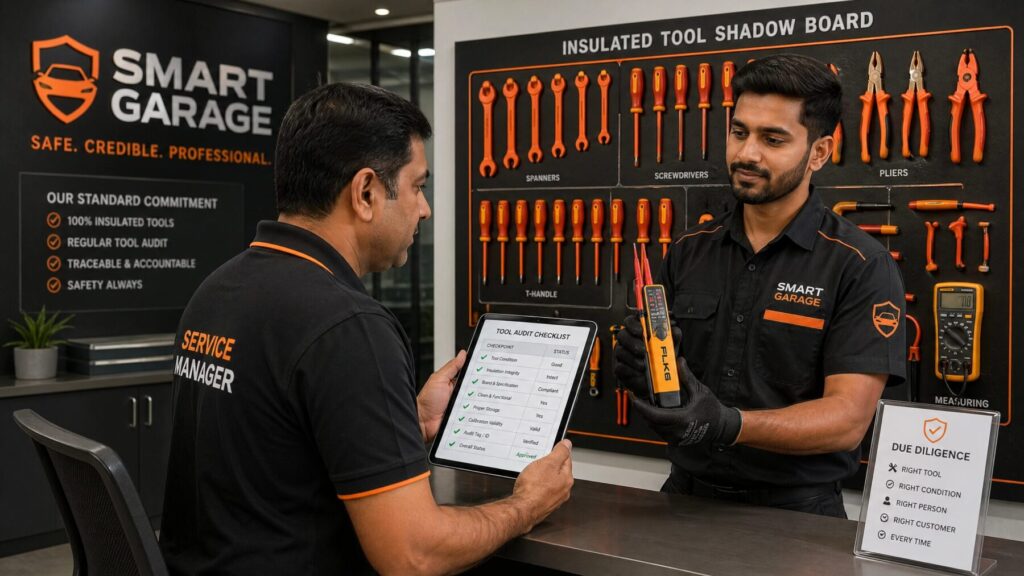
Investing in certified, branded high-voltage tooling is the starting point, not a luxury. Insulated hand tools should carry a clear IEC 60900 certification from a recognised manufacturer. Multimeters and voltage testers should be rated to CAT III or CAT IV as appropriate for the voltages being measured and that rating should come from an independent certification body rather than a self-declared label. High-voltage gloves must meet EN 60903 and be inspected and tested at the intervals specified by the manufacturer.
Regular inspection and maintenance of tools is equally important. Insulation degrades over time through heat, chemical exposure and physical wear. A tool that was certified when purchased may no longer offer adequate protection two years later if it has not been maintained and periodically retested. Workshops should build tool inspection into their standard operating procedures, with records kept and acted upon.
Training technicians to recognise the difference between certified and uncertified tooling is a practical and valuable step. Staff who can identify a genuine CAT IV rating label, spot signs of insulation wear or question the provenance of a tool they have not seen before are an active line of defence against unsafe equipment entering the workshop.
Finally, a written tool policy and periodic audit process give workshops a formal framework to work within. This demonstrates due diligence to insurers, accreditation bodies and the HSE and makes it far harder for cheap alternatives to creep in through individual purchasing decisions made under cost pressure.
8. Conclusion
The voltage is real. So are the consequences.
The UK’s transition to electric vehicles is well underway and accelerating. The workshops, technicians and training providers that serve this sector are operating in an environment where the technical demands are higher than they have ever been and where the consequences of getting things wrong are serious. High-voltage tooling sits at the centre of that risk landscape, and it deserves the same level of attention that the industry gives to technician qualifications and workshop certification.
Cheap tools are a false economy. The savings made on a multimeter or an insulated screwdriver is insignificant against the cost of a single workplace accident, a single misdiagnosis or a single customer dispute arising from an incorrect repair. The risk is not abstract. It is present in every workshop bay where an uncertified tool is picked up and applied to a live high-voltage system.
The call to action for workshop owners and managers is straightforward. Audit your tooling. Invest in certified equipment. Train your staff to understand why it matters. The technicians working in your business are your most valuable asset. The tools they rely on should be worthy of the trust they place in them.