Why UK independent workshops shouldn’t rely on just one IMI Level 4 EV-qualified vehicle technician
1. The monday morning that changed everything
One phone call. One technician. One very big problem.
Picture this. It is Monday morning. You have three electric vehicles booked in for the week, including a battery diagnostic that has been rescheduled twice already and a customer who has been waiting over a week for answers. You arrive at the workshop, make a coffee and check your messages. Then your stomach drops. Your IMI Level 4 technician has been rushed to hospital over the weekend. He will be off for at least three weeks.
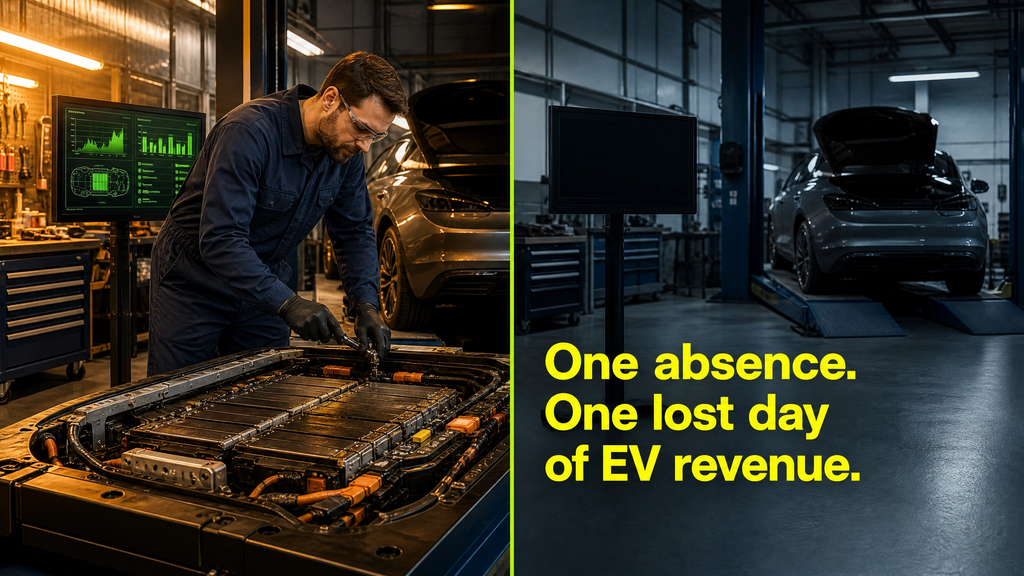
In that moment, you realise something that should have been obvious long before now. Every single piece of EV work in your workshop depends on one person. Not one team, not one department. One person. The moment he is not available, your EV capability disappears entirely. The customers with bookings will need to be turned away or redirected. The diagnostic work cannot happen. The revenue stops.
This is what business resilience specialists call a single point of failure. It is a dependency so concentrated in one place that when it breaks, the whole operation stops with it. And right now, across independent workshops throughout the UK, this is exactly the situation many owners have created without realising it.
A single point of failure occurs when one person holds a critical skill that nobody else in the business can cover. In an EV workshop, a sole Level 4 technician is precisely that. One illness, one resignation or one extended leave and your EV capability is gone entirely.
2. How we got here

Why having one Level 4 technician felt like enough
To understand how this situation develops, it helps to think about how most independent workshops have approached EV capability so far. Electric vehicles have been arriving gradually. A few hybrid cars a year ago, a handful of full EVs more recently. The sensible first response was to get one person trained. Send your most experienced technician through the IMI qualification framework, get them to Level 4 and cover the EV work as it comes in.
That approach was entirely reasonable eighteen months ago. It is becoming increasingly risky now. Almost 500,000 new battery electric vehicles were registered in the UK in 2025, according to SMMT and used EV transactions rose 45.7% to a record 274,815 in the same year. Many EVs registered in 2022, 2023 and 2024 will increasingly begin to enter the independent aftermarket as manufacturer warranty periods expire. The flow of EV work through independent workshops is not steady. It is accelerating.
A workshop that could manage its EV workload through one qualified technician in 2024 may find that same arrangement dangerously inadequate by 2026 or 2027. The volume of work is growing faster than most independent workshops have planned for and the single-technician model that once felt like a pragmatic solution is becoming a structural weakness.
3. The real risks of single-technician dependency
It is not just about holidays and sick days
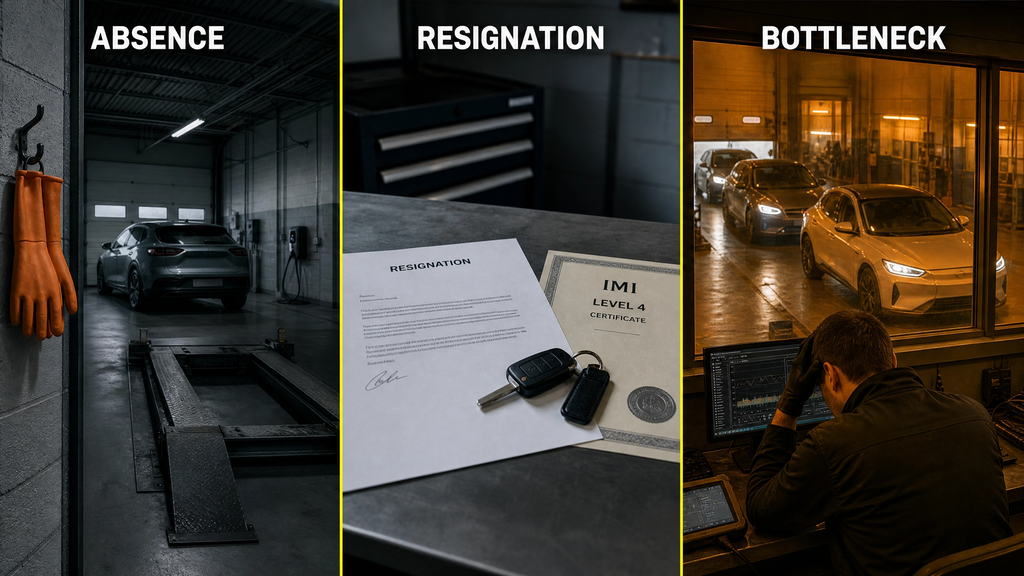
When workshop owners think about the risk of relying on one EV technician, the first scenario that comes to mind is usually absence. Holiday, illness, a family emergency. These are real and common risks that affect every member of a team at some point. Without another appropriately qualified technician or an external cover arrangement, those absences can prevent the workshop from carrying out certain Level 4 EV work. Every day that high-voltage diagnostic and repair work cannot be completed is a day of missed revenue and, potentially, a customer lost to a competitor.
But absence is only one dimension of the risk. Resignation is arguably the greater threat. The market for IMI Level 4 EV technicians in the UK is competitive and becoming more so. By the end of 2025, 74,734 UK technicians held an EV qualification according to the IMI, across all levels of the framework. Within that group, those qualified at Level 4 represent a considerably smaller subset. If your sole Level 4 technician receives a compelling offer from a main dealer or specialist EV workshop, your ability to carry out high-voltage EV diagnosis and repair leaves with them.
There is also a subtler operational risk that receives less attention. A single technician, however skilled, creates a bottleneck. If they are working on a complex battery diagnostic, other EV work has to wait. If they are tied up with a time-consuming repair, customer-facing queries cannot be properly assessed. The workflow constraints of single-person dependency affect productivity even when that person is present and available.
By the end of 2025, 74,734 UK technicians held an EV qualification across all levels of the IMI framework. Those qualified specifically at Level 4 represent a considerably smaller subset. Losing your sole Level 4 technician removes your workshop’s ability to carry out certain high-voltage EV work. Source: IMI TechSafe 2025
4. The market context making this more urgent
Why this risk is growing, not shrinking
The skills landscape around EV qualifications is not improving at the pace the market requires. The IMI reported that 2,792 technicians gained an EV qualification in Q4 2025, which was 6% higher than Q3 2025 but 17% lower than the same period in 2024. The training pipeline is not growing fast enough to match the pace of EV adoption on UK roads. The latest IMI forecast suggests that demand could exceed supply by more than 43,000 technicians by 2035.
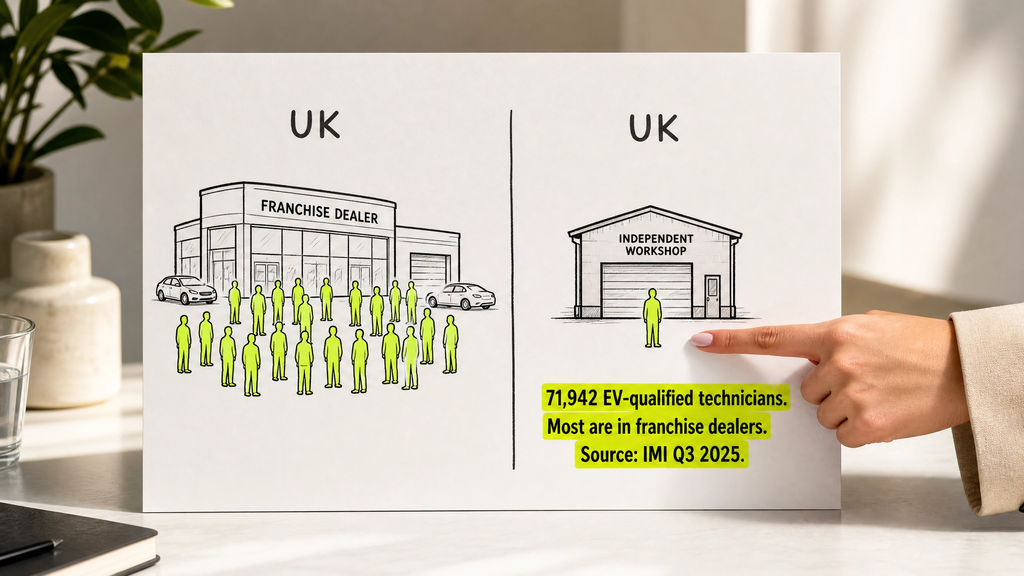
For independent workshops specifically, the distribution of qualified technicians creates an additional layer of difficulty. Analysis from Lloyd Morgan Group indicates that EV-qualified technicians remain heavily concentrated within the franchise dealer network, leaving some independent workshops and regions underserved. The recruitment process, including notice periods and onboarding, can leave a workshop without equivalent Level 4 capability for a significant period.
5. What building genuine resilience looks like
Moving from one qualified technician to a capable team
Resilience in EV capability does not require every technician in your workshop to hold an IMI Level 4 qualification. That is neither practical nor necessary for most independent workshops. What it does require is a planned, deliberate approach to distributing EV knowledge across more than one person.
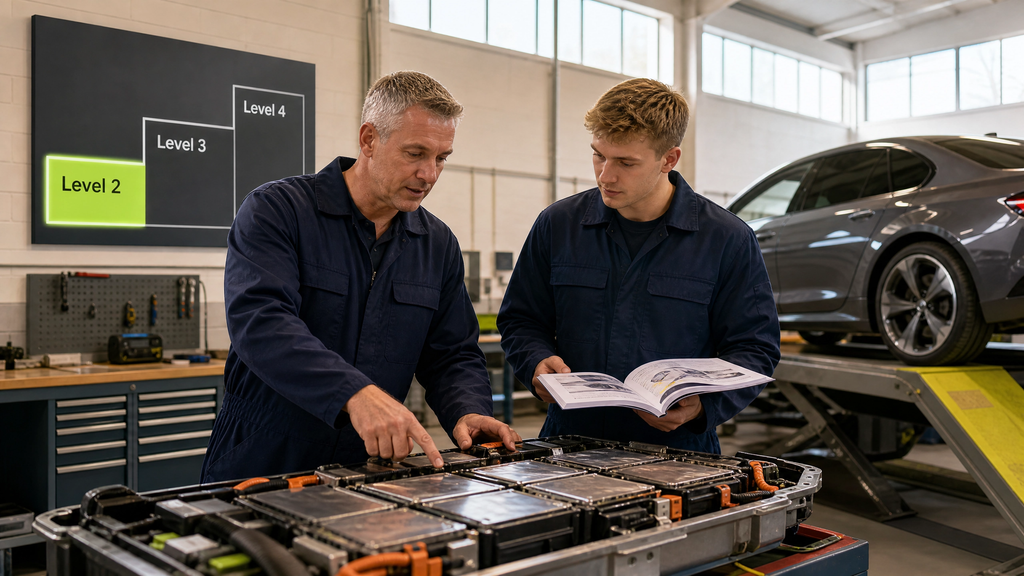
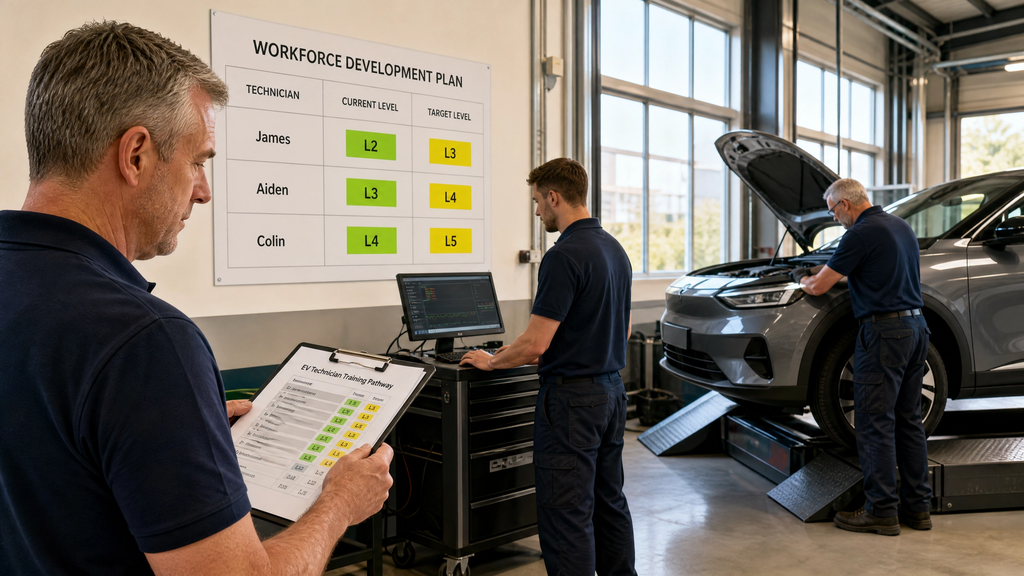
A practical starting point is identifying your second person. Which technician in your team is best placed to progress through the IMI framework towards Level 4? Getting a second technician through Level 2 and then Level 3 as a structured priority, rather than waiting until you need them to be qualified, is the most direct way to reduce your dependency on a single individual. The IMI qualification pathway generally progresses from Level 2 through Level 3 towards Level 4, with each level covering a progressively higher level of EV technical responsibility. A structured progression through the framework can build meaningful EV capability over time, provided the technician has the necessary experience, training and practical exposure.
In the short term, some workshops use IMI-qualified temporary technicians to provide cover during absences or peak demand periods. This is a legitimate and practical bridging solution that allows you to take on EV work and maintain service continuity while your permanent team develops. It is not a substitute for building internal capability, but it provides a safety net while that development is underway.
6. The commercial argument for investing in depth
Why this is a revenue decision as much as a risk decision
The case for building EV capability across more than one technician is not only about managing risk. It is also about commercial capacity. Some UK garages are charging around £80 to £130 per hour for specialist EV work, reflecting the training, diagnostic equipment and safety infrastructure involved. If demand exceeds the capacity of one qualified technician, a second technician can allow the workshop to accept more specialist work and reduce bottlenecks.
The used EV market is growing rapidly. Vehicles that were new in 2022 and 2023 are now four and five years old and increasingly likely to require diagnostic and repair work that goes beyond routine servicing. The independent workshops positioned to absorb that work, with sufficient qualified staff to handle it without bottlenecks, are the ones that will build a reputation and a customer base in this segment. Those relying on one technician will find their capacity constrains their growth at precisely the moment the opportunity is largest.
There is also a reputational dimension worth considering. A workshop that turns customers away because its sole EV technician is absent or that cannot offer timely appointments because one person is handling all EV work creates an impression that undermines confidence. Customers who experience that limitation once are likely to find an alternative and may not return.
7. Planning beyond the single technician
The steps worth taking this month
If your workshop currently has one IMI Level 4 EV technician and no backup, the most useful thing you can do right now is acknowledge that as a risk and start planning to address it. You do not need to solve it overnight. You need a clear direction and a realistic timeline.
Start by having an honest conversation with your Level 4 technician about their plans and motivations. Understanding whether they are settled in their role or actively considering their options gives you information that shapes your planning. Then identify your strongest candidate for EV development and begin mapping a training pathway. Explore available funding routes through the Adult Skills Fund and Skills Bootcamps, where eligible learners and employer-supported training programmes may qualify for government funding.
The independent workshops building EV resilience in 2026 are not doing it because they have unlimited budgets or because EV work is already overwhelming them. They are doing it because they can see what the next two or three years look like and they would rather be prepared than reactive. One IMI Level 4 technician got you started. A planned, developing team will keep you in the game.
Sources: IMI TechSafe Q3 2025, Motor Trader June 2026, SMMT EV registration data 2025, Lloyd Morgan Group February 2026, ONS Sickness Absence data, cargarages.co.uk Labour Rate Guide 2026. All figures verified at time of publication.